It's
my pleasure to introduce you to my friend, Palm Springs resident
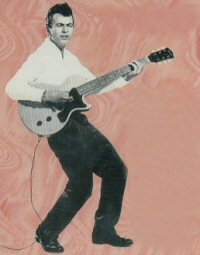
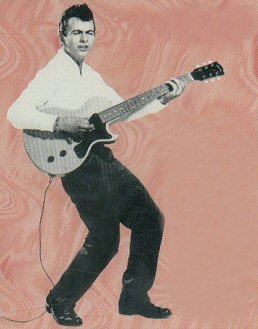
and rock & roll pioneer, Chan Romero. If you haven't
heard the name, there's an excellent chance you've heard of
his most famous song, "The Hippy Hippy Shake," which
has a long and storied history. Chan
first recorded the song in 1959 for DelFi Records, the label
immortalized by Ritchie Valens. It was also released in
England on Columbia records, where it was picked up by the Beatles, who performed it in the early 60s
at venues such as the Cavern Club in Liverpool and the Star Club
in Hamburg, Germany. In 1965, “The Hippy Hippy Shake” was
a number one hit in England by another
band from Liverpool, the Swingin' Blue Jeans. In 1988,
it appeared on the soundtrack for the movie "Cocktail,"
with a version by the Georgia Satellites. In 1994, "The
Hippy Hippy Shake" appeared on "The Beatles Live
at the BBC" album. The song has endured and stood
the test of time.
Robert
Lee Romero was born and raised in Billings, Montana.
His parents, who were from Colorado, went to Montana for employment
as migrant workers. Ethnically, he is a mixture of Mexican,
Spanish, Apache and Cherokee Indian, with a little Irish thrown
in for good measure. He got the name Chan from his grandfather,
who affectionately called him Chano. Chano eventually
shortened to Chan and it stuck. As a child he used to
listen to country music on the radio, his early heroes being
Hank Williams, Hank Snow, and Jimmy Rodgers. It was
while listening to the Grand Ol' Opry that he first heard
Elvis Presley. Later Chan saw Elvis performing "Hound
Dog" on the Steve Allen Show and knew he wanted to be
a rock & roll singer. In the summer of 1958 at
age 16, Chan hitchhiked to East L.A. to stay with relatives
and check out the music industry. It was there he wrote
"The Hippy Hippy Shake." His uncle took him
to Specialty Records, the label for which Little Richard recorded
at the time, and presented several of Chan's songs to the
A&R man, who happened to be a very young Sonny Bono.
Sonny liked a song called "My Little Ruby" and asked
Chan to polish it up a little bit and come back in a couple
of weeks. Chan had to go back to school in Montana and
never returned to Specialty Records.
When
Chan got back home, he formed his first rock & roll band
and was shortly thereafter introduced to the music of Ritchie
Valens. Many people in Billings, including his manager,
local DJ Don Redfield, thought Chan looked and sounded a lot
like Ritchie. Indeed Chan and Ritchie had a lot in common,
both being Chicano and rock & roll singer/songwriters.
Inspired by Ritchie and encouraged by the response to his
music in L.A., Chan and his band tightened up and began working
regularly around Montana. After the tragic plane crash
that took the life of Ritchie Valens, along with Buddy Holly
and the Big Bopper, Don Redfield sent a tape of Chan's music
to Ritchie Valens' manager in Los Angeles, Bob Keane.
Bob loved it and flew Chan out to L.A. Mr. Keane thought
of Chan as a successor to Ritchie Valens and signed him to
a recording contract. Chan was living a dream come true,
recording in the same studio with the same musicians on the
same label as his idol. He was introduced by Bob Keane
to Ritchie Valens' mother, who was still reeling from the
loss of her son two months earlier. She invited Chan
to come and stay at her house, which became his L.A. home
when in town over the next two years. He became part
of the family, even sleeping in Ritchie's room. He remains
close to the surviving family members to this day, often playing
at the annual Ritchie Valens Memorial Concert in Pacoima,
California.
"The
Hippy Hippy Shake" was released in July of 1959, first
in the U.S. and later in England and Australia. It sold
so well in Australia that Chan did a tour there in 1960 with
the great Jerry Lee Lewis. When he returned, he toured
the U.S. and Canada. It was the release of the song
in England that found its way to the Beatles, who who
started playing it at their club gigs.
Paul McCartney liked the song and sang it during the early
years of the group. In the mid-60s, the Swingin' Blue
Jeans' version reached #2 in England, but was #1
in Sweden, Norway and other European countries. In 1964,
Chan toured for six weeks with the Beach Boys and the Four
Seasons as a member of Buddy Holly's former group, the Crickets,
substituting for Glenn D. Hardin. It was the same year
that he first visited the Palm Springs area and decided he'd
someday like to live here. He finally made the move
to the desert in 1986. Since 1993, he's divided his
time between Palm Springs and Billings, Montana.
Chan
Romero today is better known and appreciated in England, Europe
and Australia than in the U.S. In recent years, he has
performed in Holland, England and Australia, where he gets
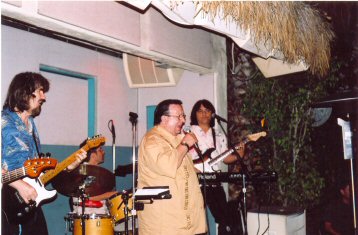
airplay and his recordings are available. I've had the
pleasure of playing guitar with Chan on some live appearances
as well as on recording sessions, including co-producing several
tracks on his "Fifties Flashback" CD in 1994.
This article was based on
an audio taped interview by Mark Guerrero with Chan Romero
in May of 1998 in Palm Springs, California.
Update
In November of 2004, Chan Romero began working on a new CD
with producer Billy Cardenas. Some of the musicians
involved in the project include Andy Tesso (formerly of the
Romancers), John Perez (of the Premiers), Willie Mondragon,
Louie Durazo, and yours truly. Cardenas is using musicians
with roots in the East L.A. music scene of the 60s to capture
that authentic "Eastside Sound." Most of the songs were
written by Chan, with a couple of covers and a Little Richard
inspired rocker that I wrote especially for Chan called "Rockin'
Like There's No Tomorrow." I played rhythm guitar on
the basic track of my song and overdubbed a lead guitar
part. I also brought in a great sax player, Steve Alaniz, who frequently plays with my band. He
played some incredible sax solos and fills on most of the
songs on the album, including an appropriately screaming solo
on my song. He also played a beautiful flute part on
one of the other songs. In the middle of the project
Billy Cardenas dropped out due to scheduling and availability
issues. After many delays, the CD was completed and
will be available in 2008.
In May and June of 2005, Chan toured Australia for the second
time in the last few years. In December, I interviewed
Chan Romero for my internet radio show, "Chicano Music
Chronicles." I played twelve of my favorite Chan Romero
tracks and we talked about them. The interview gives
insight into Chan's life and career. You can hear it at
the link at the bottom of the page.
To read my article on my experience recording my song "Rockin'
Like There's No Tomorrow" with Chan in 2004, click here.
In 2007, I interviewed Chan on video for an exhibition (and
oral history archives) of the Experience Music Project Museum
in Seattle, Washington.
On
May 15, 2007 Chan Romero was inducted into the Rockabilly
Hall of Fame at the Riverside Ballroom in Green Bay, Wisconsin,
the venue which hosted one of Ritchie Valens' last performances.
Chan Romero has the distinction of being the first Latino
rocker to be inducted into the Rockabilly Hall of Fame, which
is based in Burns,
Tennessee..
To go straight to Chan's page at the rockabilly hall's website,
click
here.
On June 1, 2008, Paul McCartney opened his show in Liverpool,
England with Chan Romero's "The Hippy Hippy Shake." Click
here to
see Paul's performance on you tube. In August of 2011,
England's Mojo Magazine had an issue with Paul McCartney on the
cover. In an article called "The Roots of Paul McCartney,"
Paul gives his top 15 early influences. Chan Romero is
number three on the list. A CD is included with the
magazine that includes "The Hippy Hippy Shake" by Chan Romero.
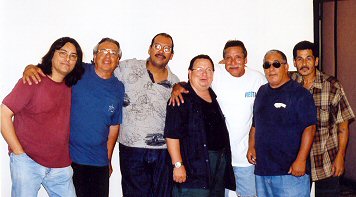
(left
to right- Mark Guerrero, Andy Tesso (formerly of the
Romancers), Louie Durazo,
Chan Romero, John Perez
(of the Premiers), Billy Cardenas, and Willie Mondragon)
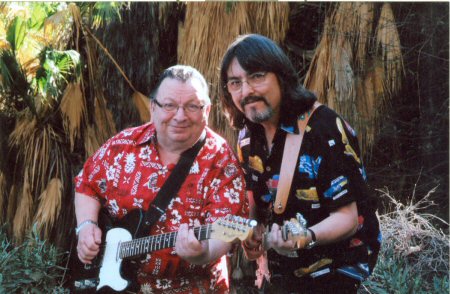
Chan Romero (2006)
(left
to right- Rick Cowling, Brian Pim, Chan Romero, and
Mark Guerrero)
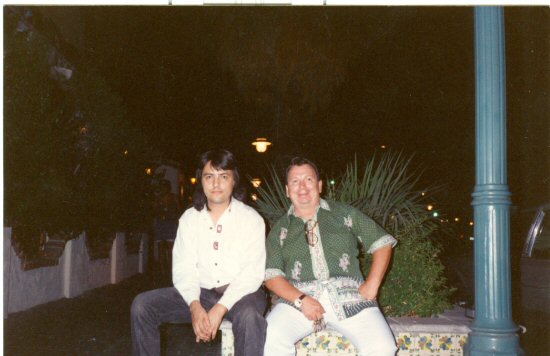
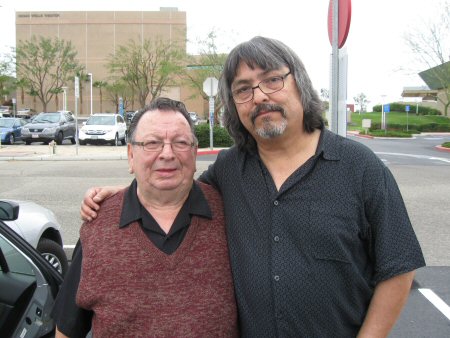
Chan Romero & Mark
Guerrero (c. 2009)
Chan Romero & Mark
Guerrero (2014)
Selected Chan
Romero You Tube Videos
"The Hippy Hippy Shake" video (2018)
"Hippy Hippy Shake" live in Liverpool, England (2018) with Mark Guerrero & Firewheels
Hear
Mark's interview with Chan Romero
on his "Chicano Music Chronicles" podcast
by clicking the play button on the photo link below
Chan Romero Recordings Featured on Show
1. The Hippy Hippy Shake
2. My Little Ruby 3. I Don't Care 4. I
Want Some More 5. Latin American Rock & Roll 6.
Hot Tamale Man 7. The Rooster 8. California
Earthquake 9. America 10. Rock & Roll Santa
Claus 11. If I Had a Way (Thrill Me So Much) 12.
Rockin' Like There's No Tomorrow
Click
here
to go to the Chan Romero store at amazon.com