Dr. Loco's
Rockin' Jalapeño Band: José Cuéllar- PhD by Day, Loco
by Night
by Mark Guerrero
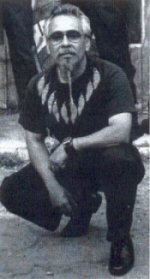
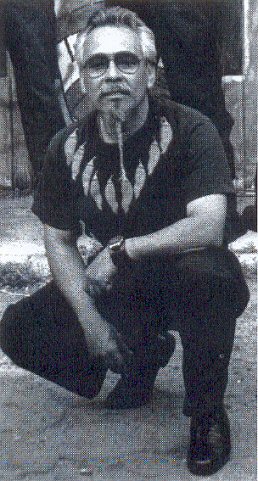
José Cuéllar aka Dr. Loco, has achieved a life and career
that can be used as inspiration to young people, especially
Chicano and minority youth. Growing up in San Antonio,
Texas, José Cuéllar wanted to be a musician. As fate
would have it, he wound up going to college and becoming a
PhD in anthropology. As if this weren't enough, he
became a musician as well, eventually founding his popular
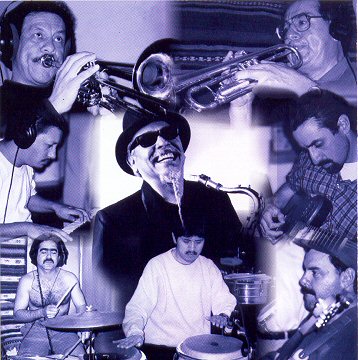
Dr. Loco's Rockin' Jalapeño Band. Based in the San Francisco
Bay Area, they have recorded four CDs and performed all over
the United States. His story proves you can have it
all if you want it and are willing to work for it.
José Bernardo (Bennie) Cuéllar, was born and raised in San
Antonio, Texas. He came from a middle class musical
family. His father played drums and trumpet, his grandfather
violin, and grandmother mandolin. José played clarinet
though grade school, before taking up the saxophone in his
late teens. The first two albums he bought were by Stan
Getz and Count Basie. Stan Getz became an early idol
and inspiration. The first band José joined was a rhythm
and blues band called the Dell Kings. He was brought
in to play second tenor sax. Another musical inspiration
for José and other young musicians was an African-American
sax player by the name of Clifford Scott. Clifford Scott
achieved musical immortality by composing and playing sax
on the classic instrumental "Honky Tonk" by Bill
Doggett. According to José Cuéllar, Clifford Scott was
also beloved in the Chicano community of San Antonio because
he would go to the barrio and bond with La Raza and teach
saxophone to young people. In 1961, José joined the
Air Force, figuring he would probably eventually be drafted
anyway. He was promised by recruiters that he would
be in the band, but was assigned to become a medic.
After basic training in Texas, he was sent to Alabama, a state
in which he was considered "colored." José
was subjected to the kind of discrimination African-Americans
were enduring at the time. He remembers buying an ice
cream cone at a well-known ice cream franchise and being told
to pick it up at the back door. On the positive side,
he was able to play with black musicians and hang out at the
blues clubs. After Alabama, he was stationed in Puerto
Rico, where he played in Latin bands and learned about the
styles of Latin music played there. His last stop in
the Air Force was Bangor, Maine, where he played in some rock
bands. During his time in the Air Force, aside from
being a dental technician, he received diverse and valuable
musical experience playing off-base. After his discharge
in 1964, he decided to pursue a career in music.
José Cuéllar returned to San Antonio and began playing in
bands. He headed for Hollywood, California with a band
called Tom Cellie & the Charades, who moved into a motel
on the Sunset Strip. This was in the mid-60s, the
height of the glory of the Sunset Strip in terms of rock &
roll. José remembers Dewey Martin, drummer for Buffalo
Springfield, getting José's band gigs in South Central Los
Angeles in r&b and blues clubs. Even though the
band was gigging some, it wasn't enough to keep up with their
motel bill. As a result, the owners held the band's
instruments hostage. They would only allow the band
to take some of their instruments on their jobs, while others
remained at the motel as collateral. One day, while
rehearsing in the motel cafe, they were heard by the cousin
of a well-known female singer named Timi Yuro, who'd had a
big hit with a song called "Hurt." The cousin
told Yuro that he had heard a great band so Yuro sent her
agent, Joe White, down to check them out. The agent liked them so much he paid their motel
bill and rented them a house in which to rehearse. The
band soon got a 36 month guaranteed contract with the Del
Webb Corporation to perform in Las Vegas at the Mint Casino.
Tom Cellie & the Charades spent the next two years living
and playing in Las Vegas. They had several matching
shark skin suits and worked out some serious rock & roll
choreography to go with their show. When the band broke
up, José returned to Southern California to the Orange County
area. He played gigs in the area and did occasional
demo sessions in Hollywood. One day José got a call
for a Motown session at Gold Star Studios. Upon arrival,
he was handed sheet music for the session. He could
read music, but not to the level where he could sight read
on the spot in the heat of a big-time session. He was
dismissed. For a time, José thought he might give up
music.
After some soul searching, he decided to go to Golden West
College in Huntington Beach and improve his music reading
and knowledge. On registration day, he found that all
the music classes were filled to capacity. He also
noticed everyone in line was Anglo and looked like a surfer,
male and female. It was as if he were dropped onto the
set of "Beach Blanket Bingo." He didn't feel he would
fit in very well. He started to walk away when a
student stopped him and said "where are you going?"
After a discussion about what José was interested in, the
student said one of the music teachers, Tom Hernandez, had
played trumpet with Frank Sinatra in Vegas. This
definitely piqued Jose's interest. The student took
him to meet Mr. Hernandez. To this day José Cuéllar doesn't know
the identity of the student who affected the course of his
life. Tom and José had a long talk over a "cafecito"
(cup of coffee) while José filled out registration forms.
Tom Hernandez then opened a cabinet door full of musical instruments
and invited José to pick out what he wanted. He took
an alto and tenor saxophone, clarinet, and flute. Tom
Hernandez became José's mentor. After a year of music
and band classes, Mr. Hernandez said to José take some
other kinds of classes. "I don't want to see you around here
anymore. Maybe you can get a degree." José
took classes in different subjects and soon had the credits
for an A.A. degree in music. It was suggested he go
on to Long Beach State where they had an excellent music program.
Since Richard and Karen Carpenter had attended the program,
it was more popular than ever. José could not get into
a single music class. He thought maybe sociology would
be a good major because a lot of social and political events
were occurring in 1968, such as the assassinations of Martin
Luther King and Robert Kennedy, the East L.A. high school
walk outs, and the Cesar Chavez march on Sacramento.
However, the sociology classes were also filled to capacity.
He walked into an anthropology class. The teacher said
there was no room. As he was walking away, she stopped
him and said maybe she could squeeze in one more student.
She asked José what other classes he had and he replied "none."
He explained every class he wanted was full. She wound
up taking him around to other anthropology classes and helping
him to get in. He now had a full-time load of anthropology
classes. He found that he really liked the subject matter
and that he was very good at it. Two years later, he
had a Bachelor's degree in anthropology!
José Cuéllar still had the G.I. bill and access
to fellowships to attend graduate school at U.C.L.A.
He wasn't sure he wanted to go there and give up his musical
aspirations. His favorite psychology teacher advised
him to try it and if he didn't like it he could quit anyway.
It wasn't something he had to commit to continue. He
gave it a shot and found he enjoyed it and once again did
very well. Cuéllar eventually graduated from U.C.L.A.
with a masters degree and a PhD. in anthropology. This
led to teaching jobs at the Claremont University (early 70s),
the University of Colorado at Boulder (1977-78), U.C. Santa
Barbara (1978-79), San Diego State (1980-83), and Stanford
University (mid-80s-1990). He's also been a guest professor
at U.C. Berkeley. All through José's college career
as a student and teacher, he had been playing in bands on
weekends. However, while in Colorado in 1977 he found
he had no one to play music with so he hung up his sax for
many years.
While teaching at the prestigious Stanford
University in Palo Alto, California, he formed his first
band which was cleverly called the Contra Contraband, whose
purpose was to raise money for the activists who were fighting
the Contras in Nicaragua. In 1988, he was asked by teacher/writer
Antonio Burciaga to put a band together to play at a mural
dedication at Casa Zapata. He put one together using
mostly Stanford students and called it Dr. Loco's Original
Corrido Boogie Band. The name was inspired by the style
of the name Sgt. Pepper's Lonely Hearts Club Band and the
Original Dixieland Band. The name Dr. Loco originated
while doing research on cholos in Tijuana while teaching at
San Diego State. Dr. Cuéllar was intrigued as to how cholos, who originated in the American Southwest, evolved
south of the border. His paper was entitled, "The
Development and Diffusion of Cholismo in Urban Barrios Along
the U.S.- Mexico Frontera,"1975-1988.
While developing relationships
with the cholos in Tijuana, one of them had heard that
José was a doctor (PhD). He thought it was funny and
began taunting Dr. Cuéllar in a good natured way saying "a poco Dr. Loco," which got a big laugh from the other
vatos. They all started calling him Dr. Loco.
Dr. Cuéllar thought it sounded like a good name for his musical
alter ego since rock & roll already had a Dr. John, Dr.
Hook, and Professor Longhair.
Dr. Loco's
Original Corrido Boogie Band played the mural event
at Casa Zapata and sounded very good. An article appeared in the San
Francisco Chronicle about this PhD moonlighting in a rockin'
Latino band. Another article appeared in the Stanford
newspaper, which led to Dr. Cuéllar meeting his early musical
hero, Stan Getz, who happened to be an artist in residences
at Stanford at the time. The San Jose Mercury News also
wrote a story in which they referred to José Cuéllar as a
"pair of docs" (a play on the word paradox), meaning
he was both Dr. Cuéllar and Dr. Loco. The stories created
a lot of interest in the band and the gigs started coming
in. The name of the band was changed in 1990 to its
present Dr. Loco's Rockin' Jalapeño Band. The Jalapeño
part of the name came from a radio station in San Antonio
that José enjoyed as a youngster called Radio Jalapeño, KEDA.
What he liked about it was that it played an eclectic mix
of the kinds of Latin music he liked; corridos, Lalo Guerrero
music, and Chicano rock and blues. His band had a similar
mix of music. José wisely knew the band's new name was
an attention getter and lent itself to marketing.
José found out he was onto something when Dr. Loco's Rockin'
Jalapeño Band performed at the Viva Chicago Festival, where
they held their own with music veterans Ruben Blades and Little
Joe Hernandez. Dr. Loco's Rockin' Jalapeño Band recorded their
first album in 1991 called "Con / Safos."
Albums to follow include "Movimiento Music" (1992),
"Puro Party" (1995), and "Barrio Ritmos &
Blues" (1998). I have two of the CDs, so I can
only comment on those. "Con / Safos (1991) is an
excellent album and a lot of fun. It's bilingual and
very pocho. The band covers James Brown's "I Got
You (I Feel Good)," but call it "I Got You (I Feel
Chingon)." They also have a bilingual and highly
suggestive version of the classic doo wop song "Cherry
Pie" they call "Chile Pie." The Mexican
standard "Volver, Volver" becomes "Volver,
Return." Lalo Guerrero's "Los Chucos Suaves"
is also included and I'm happy to say the CD is dedicated
to my dad, "El Maestro Lalo Guerrero." The
album also has a cumbia, cha cha, Dr. Loco's version of "The
Girl From Ipanema" as "Homegirl de la Misión."
Chuck Rio's "Tequila" ends the CD, but on the breaks
the band shouts "jalapeño" instead of "tequila."
It's good time music played very well. "Barrio
Ritmos & Blues" (1998) has a bilingual and "pochocized"
version of Stephen Stills' "For What It's Worth"
and, my favorite cut, "Barrio East Los." It's
a monster funky track about my home town of East L.A.
It's very hip with a kind of rap that's more like urban poetry.
The last track on the CD has a recitation of the ingredients
for menudo to a musical groove, hilarious.
The
musicians in the band, including Dr. Loco, are not only entertaining,
they can play! It's an excellent band. Dr.
Loco's band began touring in 1993 and continues to perform
at prestigious festivals, clubs, and events throughout the
U.S. Current members of the Rockin' Jalapeño Band are
Saul Sierra, bass, vocals, David Stephens, valve trombone,
trumpet, vocals, Brian Andres, trumpet, Tom Ledesma, trumpet,
Steve Cervantes, flute, harmonica, tres, vocals, Ron Torrez,
guitar, vocals, and Carlos Caro & Stan Ginn, percussion,
timbales, congas. In 1997, José "Dr. Loco"
Cuéllar and Francisco Herrera, a well-known guitarist, vocalist,
and activist, created an electro-acoustic group to perform musica Americana of amor and liberation called Amorindio.
Their unique bilingual arrangements bring new voice and high
energy to some of the great classic and contemporary boleros,
freedom songs, polkas, cumbias, and gospels. Multi-instrumentalist
and vocalist Daniel Martinez plays electric bass. Joe
Brigandi or Carlos Caro of Dr. Loco's Rockin' Jalapeño Band
sometimes joins this group on percussion, drums, and vocals.
Amorindio has been performed at Princeton University, Grand Valley
State University (Michigan), the Summer of Love 30th Anniversary
in San Francisco, the Berkeley Art Museum at U.C. Berkeley,
and many other venues.
José "Dr. Loco" Cuéllar first met my dad, Lalo Guerrero,
at an event at which my dad received the Feathered Serpent
(Quetzalcoatl) Award at Luis Valdez' Teatro Campesino in San
Juan Bautista, California. Dr. Loco had been invited
to perform by Luis Valdez. It was a star-studded event
with Linda Ronstadt, Edward James Olmos, and Paul Rodriguez.
Dr. Loco's band backed Eddie Olmos at the
event. Eddie sang several of my dad's pachuco songs
that had been featured in the Luis Valdez play and movie "Zoot
Suit." This gave Dr. Loco an opportunity to learn
some of my dad's songs and become familiar with them.
This turned Dr. Loco on to my dad's pachuco music and resulted in
the recording of his own version of my dad's classic "Los Chucos Suaves" on Dr. Loco's Rockin' Jalapeño Band's
first album, "Con / Safos." Dr. Loco and his
band backed my dad at an event in San Jose a few years later.
This was at a time when my dad was in his early 80s and was
having some trouble at times remembering his lyrics.
I spoke to Dr. Loco on the phone prior to the performance
and gave him a heads up on the lyric situation. Dr.
Loco made sure one of his vocalists was at the ready with
the lyrics in case of any problems. As it turned out,
my dad rocked the house, with the exception of one song on
which he needed a little help. Dr. Loco's Rockin' Jalapeño
Band also shared the bill with my dad at Arizona State University
in Tempe, Arizona, a show I have on video tape. Dr.
Loco and I hadn't met in person until I interviewed him for
this article over breakfast in a South San Francisco IHOP
in April of 2005, while I was in town to speak at a Chicano
music class at U.C. Berkeley. I found him to be a bright
and exuberant man, who's enthusiastic about music and
life in general. Hopefully, we can do some music together
in the future, live or in the studio.
Dr. Cuéllar is currently Professor and Chair of La Raza Studies
at San Francisco State University and Director of the Cesar
Chavez Institute for Public Policy. José B. Cuéllar,
PhD combines his talent as a United States Mexican multi-cultural
anthropologist, musician, educator, and activist in three
entertaining and inspiring presentations: Dr. Loco's Rockin' Jalapeño Band, Amorindio, and Professor Cuéllar.
As Professor Cuéllar, he appears around the country presenting
an entertaining educational multi-media lecture on the diverse
origins of Mexican-American musical heritage, spanning
from the 19th century to the present on both sides of the
U.S.- Mexican border. His academic credentials, lectures,
and writings, as well as his musical credits are too numerous
to mention in this article. You can get additional information
on José "Dr. Loco" Cuéllar on his website,
drloco.com.
This article
is based on an audio taped interview by Mark Guerrero with
José "Dr. Loco" Cuéllar on April 5, 2005 in San
Francisco, California.
Hear
Mark's interview with Dr. Loco
on his "Chicano Music Chronicles" podcast
by clicking the play button on the photo link below
Dr. Loco
Recordings Featured
1. Pa' Lo Que Vale 2.
I Feel Good (I Feel Chingón) 3. Cumbia Del Sol
4. Picket Sign 5. Chile Pie 6. Los Chucos
Suaves 7. Famed 8. Barrio Trilogy Plus
a.)Barrio East Losb.) I'm In Heaven c.)
Barrio Missión 9. Volver Return 10. Vamos a
Bailar 11. Me Siento So Bad 12. Linda Cholita
13. Camelia the Chicana 14. Look-Ka Py Py
15. Dance 'Til I Drop
Click
here
to go to the Dr. Loco store at amazon.com