After
having written seven articles featuring Chicano musical artists,
I think it’s about time I write about my dad, Chicano
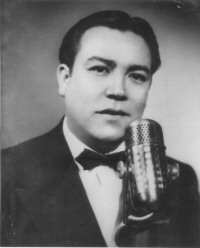
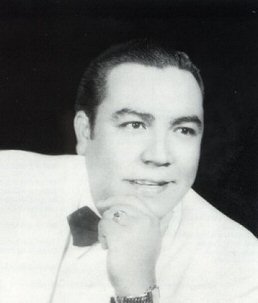
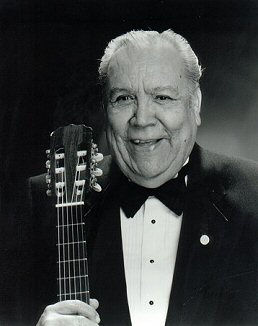
music legend Lalo Guerrero. Lalo
Guerrero is rightfully recognized as the “Father of
Chicano Music” because no other Chicano artist
has come close to writing and recording more great songs in
virtually every genre of Latin music, including salsa, norteña,
banda, rancheras, boleros, corridos, cumbias, mambos, cha
cha chas, socially relevant songs, swing, rock & roll
and blues. He has also created children’s music,
comedy songs and parodies, in addition to being a world-class
singer. Generations of children in Mexico and the U.S.
grew up with his “Ardillitas” (squirrels), and
his parodies such as, “Tacos for Two,” “Pancho
Claus,” “Elvis Perez” and “There’s
No Tortillas,” have brought laughter to Chicanos and
people of all races and ethnicities. His songs about
Cesar Chavez and the farm workers, the braceros, martyred
journalist Ruben Salazar, and the plight of illegal aliens,
have chronicled Chicano history and inspired his people.
He’s the only Chicano I know of who has written songs
that have become standards in Mexico. His “Cancion
Mexicana” was covered by legendary singers such as,
Lucha Reyes and Lola Beltran, while “Nunca Jamas”
was recorded by the equally legendary Trio Los Panchos, Javier
Solis, and Jose Feliciano. As Jesus Velo, bassist for
Chicano punk band Los Illegals,
recently quipped, “Lalo’s the first Chicano to
cross back” (as opposed to crossover). His Pachuco
music of the late 40s and early 50s provided the sound track
to Luis Valdez’ late 70s play and movie, “Zoot
Suit.” All the above offers just a glimpse of
over 700 songs he’s recorded since his first record
in 1939, with Los Carlistas on Vocalion Records.
Lalo
Guerrero has performed all over the United States, Mexico
and in Paris, France. He has received countless awards,
including being declared a National Folk Treasure by the Smithsonian
Institution in Washington D.C., a National Endowment of the
Arts Fellowship, a Nosotros Lifetime Achievement Award, and
the National Medal of Arts, presented by President Clinton.
He has been invited to the White House three times, by Carter,
Bush Sr., and Clinton. Not bad for a kid who was
born and raised in the Barrio Libre section of Tucson,
Arizona to a large family of limited financial means. His
father, Eduardo Guerrero, who was born in La Paz, Baja California,
worked for Southern Pacific Railroad as a boilermaker. Lalo didn't finish high school due to the depression and had
no formal musical education. His first group, Los Carlistas,
represented Arizona at the New York World’s Fair of
1939 and, while still in New York, appeared on the Major Bowes
Amateur Hour on national radio. He appeared in a few
Hollywood movies, including, “Boots and Saddles”
starring Gene Autry and “His Kind of Woman” starring
Robert Mitchem and Jane Russell. When Lalo moved to
Los Angeles in the 40s, he recorded about 200 songs for Imperial
Records, with the Trio Imperial and as a soloist. He
performed as a solo front man for years at the legendary Bamba
Club near Olvera Street and later, in the 50s, formed his
own orchestra and played for years at the Paramount Ballroom
in East L.A. and toured extensively around the Southwest.
In the 60s, with the proceeds from his national hit, “Pancho
Lopez,” he bought his own night club called “Lalo’s,”
where his orchestra regularly performed. In 1972, after
ten successful years, he sold it and moved to Palm Springs,
California.
My
musical relationship with my dad goes all the way back to
the 60s when my teenage band, Mark & the Escorts,
backed him on several records and even toured with him a few
times around California and Arizona. It was great experience
for a bunch of 14 year olds. The most successful song
we recorded with him in that era was “La Minifalda de
Reynalda.” It was a big hit in the Southwest and
has been covered by many artists in Mexico. In the late
70s and early 80’s, I collaborated with him on many
of his children’s records, “Las Ardillitas de
Lalo Guerrero.” Typically it would go something
like this: I would write the music of a song, usually
rock, and he would write the Spanish lyric. I would
put together a band and cut the tracks. We’d fly
to Mexico City, where his label, EMI Capitol, was based, and
do the vocals. Yes, I would be one of the “Ardillitas.”
We’d stay a week, recording and enjoying the great city.
My dad has also written Spanish lyrics for some of my rock
songs, such as the all-Spanish version of “On the Boulevard.”
We also collaborated on a ballad entitled, “Receta de
Amor,” which was my music and his lyric. Also
in the early 80s, during the Fernandomania era, we each
wrote a song about Dodger pitcher, Fernando Valenzuela.
It was released as a 45 and sold at Dodger Stadium.
Dad did the vocals on his “Ole Fernando” and my “Fernando,
El Toro.” The arrangements were done by Jose Hernandez
, founder and leader of the great mariachi, Sol de Mexico.
In 2001, these recordings were used in a documentary on
Fernando Valenzuela, "Fernandomania," on the ESPN
Classic cable network.
As
far as live performances with my dad are concerned, we performed
in 1985 at the Southwest Museum in Highland Park, California,
where I did a set of my material, followed by him doing a
set of his. The program was entitled, “Two Generations
of Mexican-American Music in L.A." In 1990, we
performed with the same format at the Barnsdall Art Center
Theater in Los Angeles. In 1998, my dad asked me to
perform with him in Paris, France at the Cite de la Musique.
We put together a small band, in which I played lead guitar
and was musical director. I also performed two of my
songs. The tremendous response we received from the
French audience led to enlarging the band to six-pieces and
performing eleven concerts from 1998 through 2000. We
performed at the new Getty Center in L.A., the Annenberg Theater
in Palm Springs, the Luckman Auditorium at Cal State L.A.
(my alma mater), Spotlight Casino in Indio, CA, and in my dad's hometown, Tucson, Arizona,
to name a few. At every concert, I performed two or
three of my songs in the show. I feel very fortunate
that circumstances made it possible for me to perform with
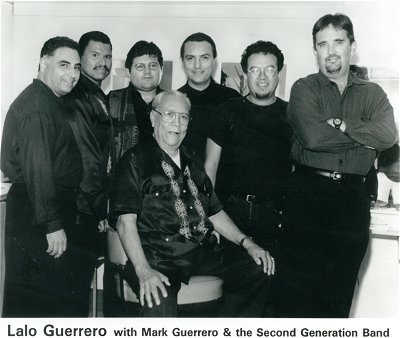
my dad. We called the group Lalo Guerrero with Mark
Guerrero and the Second Generation Band. It’s amazing
that in his 80s, my dad was still able perform at a high level and give a great show that could captivate
and thrill an audience. He deservedly is considered
an icon and a legend to the Chicano people.
Lalo
Guerrero has a parody CD out, “The Funny Side
of Lalo Guerrero,” on Brown Bag Records, which includes
his classic “Tacos for Two,” “Pancho Claus,”
"There's No Tortillas," “No Chicanos on TV,”
and eight others. He also has a great CD out called, “Vamos
a Bailar Otra Vez.” Recorded in 1999, it’s
a collection of new versions of some of his greatest songs,
including, “Vamos a Bailar,” “Marijuana
Boogie,” “Nunca Jamas” and “Barrio Viejo,” as well as a recent song, “El
Carnalito.” This album has world-class musicians
and arrangers, with a big band composed of some of the members
of the Brian Setzer Orchestra. It’s available
on Break Records.
Updates
In 2002, Lalo Guerrero's autobiography,
written with Sherilyn Meece Mentes, was published by the University
of Arizona Press. (You can read about it on my "Miscellaneous
Writings" page). Also in 2002, Lalo performed at
legendary Notre Dame University and a compilation CD of some
of his best recordings of the 60s was released, "Lalo
Guerrero, El Chicano Inolvidable." In May of 2004,
Lalo was given an award by the Los Angeles Historical Society
at a ceremony in Los Angeles. One of the other recipients
was legendary science fiction writer, Ray Bradbury.
I was fortunate to perform with my dad several times in 2003
and 2004. By then I had formed my current band Mark
Guerrero & Radio Aztlán. We backed him on a
couple of songs at the Gene Autry Museum in Los Angeles, the
first time in 2003 and again in 2004. At the latter
concert, I also performed a few songs with him as an
acoustic duo. In June of 2004, we were on a television
show together in the Palm Springs area, "The Talking Stick."
We were interviewed and performed a few songs acoustically.
On July 10, 2004, I performed with my dad at the Levitt Pavilion
in Pasadena with a three-piece band.
The
last time I ever performed with my dad was on October 3, 2004
at the tribute concert for Don Tosti, who had recently passed
away. I was performing a four-song set with a band which
included Ry Cooder on guitar. We brought him up to sing
his "Los Chucos Suaves" with us. He and I
traded verses and he even danced during the instrumental interludes
to the crowds delight. He performed one more time with
Mariachi Cobre in his hometown of Tucson, Arizona in
November. His health began to fail rapidly after that
and he never performed again. Lalo Guerrero passed away peacefully on March
17, 2005 at the age of 88. Imagine, five months before
he passed away he was still performing and bringing down the
house. In June of 2005, three months after his passing,
a CD by Ry Cooder was released, "Chavez Ravine." It
includes three songs on which my dad sang lead vocals, a
song he wrote for the project, "Corrido de
Boxeo," and new versions of his classic compositions "Los
Chucos Suaves" and "Barrio Viejo." He
recorded the project in January of 2003 at the age of 86 with
a still strong and vibrant voice. It's fitting that
even after he's physically no longer with us, he's on a great
new CD which will help to advance Chicano music to a new mainstream
audience. Lalo Guerrero was without a doubt the greatest
Chicano musical artist of all time. He was one of a
kind and there will never be anyone like him. Thankfully,
his music is with us and will endure for generations.
In 2000,
my brother Dan and I donated our dad's archives (records,
cds of his recordings, photos, posters, etc.) to CEMA (California
Ethnic Multicultural Archives) at the University of California
at Santa Barbara. There they will be preserved and made
available to researchers for generations to come. To
view the Lalo Guerrero webpage on the CEMA website clickhere. On April 17, 2005, Lalo Guerrero was posthumously
inducted into the Arizona Music Hall of Fame. I performed
two of his songs at the ceremony/show. The next day,
April 18, 2005, a proclamation was read on the floor of the
Arizona House of Representatives in Phoenix, Arizona.
To read my article on the two events click here.
In December
of 2005 my internet radio show, "Chicano Music Chronicles"
had it's debut. My first show appropriately featured
the music of Lalo Guerrero. I played 12 of my favorite Lalo Guerrero tracks. My show, which usually includes
an interview with the featured artist, was not possible because
my dad had passed away nine months prior. The show
nonetheless gives insight into Lalo's music and career.
I made comments on each song, sharing what information I had
about it.
You can hear it at the link at the bottom of the page.
In October
and November of 2006, a documentary on the life and career
of Lalo Guerrero, "Lalo Guerrero: The Original Chicano"
will be airing on PBS stations across the United States.
The documentary was produced by my brother Dan Guerrero and
Nancy De Los Santos. It features luminaries such as Ry Cooder, Linda Ronstadt, Cheech Marin, Paul Rodriguez, Los
Lobos, Edward James Olmos, Cesar Chavez, Dolores Huerta, and
Luis Valdez rhapsodizing about Lalo Guerrero and his music.
It's a magnificent documentary that will serve as an
enduring record of who my dad was and his musical
achievements.
Lalo Guerrero
with Mark Guerrero
& the Second Generation Band
(Left to right: Bobby Dominguez, Lorenzo Martinez, Steve
Alaniz, Lalo Guerrero (seated),
Mark Guerrero, Willie Loya and Alex Armstrong)
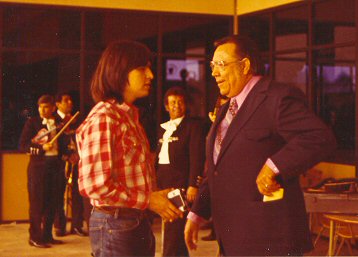
Mark & Lalo Guerrero (1972)
(Robert
F. Kennedy Elementary School- East L.A.)
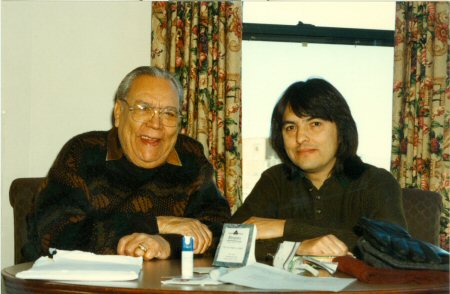
Lalo & Mark (1997)
(Washington
D.C.)
Selected Lalo
Guerrero You
Tube Videos
Lalo Guerrero "Muy Sabroso
Blues" (1999) (Mark Guerrero on lead
guitar)
Lalo & Mark Guerrero "Receta de
Amor" (1986)
(music by Mark Guerrero, lyric by
Lalo Guerrero)
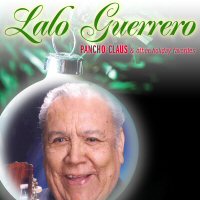
Lalo Guerrero
Christmas Album "Pancho Claus & Other Holiday Favorites"
download available at
amazon.com for only $6.99!
"Pancho Claus & Other Holiday Favorites"
Hear Mark's show featuring
recordings of Lalo Guerrero
on his "Chicano Music Chronicles" podcast
by clicking the play button on the photo link below
Lalo Guerrero Recordings Featured on Show
1. El Chicano 2.
Los Chucos Suaves 3. La Minifalda de Reynalda 4.
Tin Marin De Do Pingue 5. Pecadora 6. There's No Tortillas 7.
El Corrido de Deleno 8. Los Greñudos 9. Nunca Jamas
10. Do You
Believe in Reincarnation? 11. Manzanita 12. No
Chicanos On TV 13. Barrio Viejo