At last, a book about the San Francisco bay area Latin rock
boom of the late 60s that spawned Santana, Malo, Sapo, Azteca,
and others. "Voices of Latin Rock" by Jim
McCarthy with Ron Sansoe, published by Hal Leonard, fills
in many of the missing pieces in my knowledge of Latin rock
history of Northern California. Being a part of the
Southern California Chicano rock scene since the early 60s,
what went on in the parallel universe of the bay area was
unknown to me and my contemporaries. We certainly heard
Santana's first album, which contained the mega hit "Evil
Ways," coming over the radio airwaves and were profoundly
influenced by it. However, how it all happened and the
musicians involved was not available to us until now.
Jim McCarthy, who is described in the book as a first generation
Irish kid living in England, got into Latin rock via American
soul and r&b to the point where his hair (both facial
and on his head) and style of clothing, reflected the splendor
of the Northern California Latin rock brethren. McCarthy
also has books about Kurt Cobain, Eminem, and Tupac Shakur
to his credit. One of the things that became clear to
me about a major difference in what went on in the bay area
and East L.A., where I grew up, was the diversity of the Latino
community. In East L.A., the Latino population was almost
exclusively Mexican-American (Chicano). In the San Francisco/Oakland
area there were many people from the Caribbean, Central America,
and South America, mixed in with Mexicans and Chicanos.
This diversity brought into the musical melting pot the instruments
and musical styles of the various countries of their origins.
What happened in San Francisco in the late 60s was spontaneous,
original, and very important in the history of Latin rock,
however, contrary to the book's pronouncement that it was
where and when Latin rock was born, I must respectfully disagree.
My dad, Lalo Guerrero, was writing and recording swing, blues,
and boogie woogie in the late 40s, as well as rock & roll
in the mid-50s, in Spanish and bilingually. Ritchie
Valens' "La Bamba" could also certainly be called
Latin rock as well. This is not to diminish the importance
or the power of the explosion that occurred in San Francisco's
Mission District in the late 60s. They fused Latin rhythms
and musical forms from all over the Latin world with rock,
blues, psychedelia, funk, and jazz in a way that had not been
done and moved us along the evolutionary path on which we
travel today.
"Voices of Latin Rock" is well-written and well-researched, with many of the principals interviewed for the
book. It gets deeply into the music, personalities,
drugs, and the surrounding social context of the times, in
a straight forward and honest way. Near and dear to
my heart, is a chapter entitled "Viva Tirado / East
L.A.," which talks about El Chicano in some detail, along
with other East L.A. bands of the era. El Chicano
would often play up in the bay area along side the San Francisco Latin rock
bands of the era. The chapter also rightly credits East
L.A.'s Village Callers with recording a version of "Evil
Ways," which preceded Santana's hit version. Other
East L.A. bands mentioned include Thee Midniters featuring
Little Willie G, Cannibal & the Headhunters, Macondo,
Tierra, Redbone, Yaqui, and my '70s band, Tango. It also
mentions the Eastside bands that followed in the late 70s/early 80s, Cruzados, Los Illegals,
and Los Lobos. A later chapter called "Love Will
Survive" tells the story of Little Willie G's tenure
as Malo's lead vocalist on their fourth album, "Ascension."
He also toured extensively with Malo that year. The
chapter also gives some additional information on Little Willie
G's former band from East L.A., Thee Midniters, and his later
work with Little Ray Jimenez in God's Children. As I
mentioned earlier, San Francisco's Mission District and East
L.A. of the period were parallel universes, separated by a
mere 400 miles. Both areas had a Latin music boom; an
art movement, which included an explosion of urban street
murals; a cultural renaissance which included a return to
ones Latin roots regarding clothing, food, music, theater,
and literature. We were both struggling over the Viet
Nam war and the disproportionate numbers of Latinos that were
being sent to a war whose purpose was not clear. We
also both supported Cesar Chavez and his farm worker's movement
and union, the UFW. Aside from all the detailed information
on the music and musicians of the period, the book has a forward
by Carlos Santana, over 800 rare photographs, a cast of characters
list, glossary of terms, resources page, and discography.
"Voices of Latin Rock" is an essential part of any
Chicano/Latino music library. I highly recommend it.
The day after finishing the book, I went up to San Francisco,
where I was scheduled to speak to a Chicano music class at
U.C. Berkeley. While in town, I toured the Mission District
and visited with several musicians who were in the book.
The story of that visit will follow this article on the next
"Miscellaneous Writings" article.

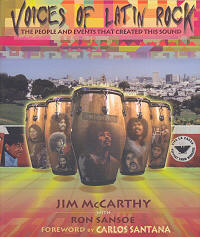 At last, a book about the San Francisco bay area Latin rock
boom of the late 60s that spawned Santana, Malo, Sapo, Azteca,
and others. "Voices of Latin Rock" by Jim
McCarthy with Ron Sansoe, published by Hal Leonard, fills
in many of the missing pieces in my knowledge of Latin rock
history of Northern California. Being a part of the
Southern California Chicano rock scene since the early 60s,
what went on in the parallel universe of the bay area was
unknown to me and my contemporaries. We certainly heard
Santana's first album, which contained the mega hit "Evil
Ways," coming over the radio airwaves and were profoundly
influenced by it. However, how it all happened and the
musicians involved was not available to us until now.
Jim McCarthy, who is described in the book as a first generation
Irish kid living in England, got into Latin rock via American
soul and r&b to the point where his hair (both facial
and on his head) and style of clothing, reflected the splendor
of the Northern California Latin rock brethren. McCarthy
also has books about Kurt Cobain, Eminem, and Tupac Shakur
to his credit. One of the things that became clear to
me about a major difference in what went on in the bay area
and East L.A., where I grew up, was the diversity of the Latino
community. In East L.A., the Latino population was almost
exclusively Mexican-American (Chicano). In the San Francisco/Oakland
area there were many people from the Caribbean, Central America,
and South America, mixed in with Mexicans and Chicanos.
This diversity brought into the musical melting pot the instruments
and musical styles of the various countries of their origins.
What happened in San Francisco in the late 60s was spontaneous,
original, and very important in the history of Latin rock,
however, contrary to the book's pronouncement that it was
where and when Latin rock was born, I must respectfully disagree.
My dad, Lalo Guerrero, was writing and recording swing, blues,
and boogie woogie in the late 40s, as well as rock & roll
in the mid-50s, in Spanish and bilingually. Ritchie
Valens' "La Bamba" could also certainly be called
Latin rock as well. This is not to diminish the importance
or the power of the explosion that occurred in San Francisco's
Mission District in the late 60s. They fused Latin rhythms
and musical forms from all over the Latin world with rock,
blues, psychedelia, funk, and jazz in a way that had not been
done and moved us along the evolutionary path on which we
travel today.
At last, a book about the San Francisco bay area Latin rock
boom of the late 60s that spawned Santana, Malo, Sapo, Azteca,
and others. "Voices of Latin Rock" by Jim
McCarthy with Ron Sansoe, published by Hal Leonard, fills
in many of the missing pieces in my knowledge of Latin rock
history of Northern California. Being a part of the
Southern California Chicano rock scene since the early 60s,
what went on in the parallel universe of the bay area was
unknown to me and my contemporaries. We certainly heard
Santana's first album, which contained the mega hit "Evil
Ways," coming over the radio airwaves and were profoundly
influenced by it. However, how it all happened and the
musicians involved was not available to us until now.
Jim McCarthy, who is described in the book as a first generation
Irish kid living in England, got into Latin rock via American
soul and r&b to the point where his hair (both facial
and on his head) and style of clothing, reflected the splendor
of the Northern California Latin rock brethren. McCarthy
also has books about Kurt Cobain, Eminem, and Tupac Shakur
to his credit. One of the things that became clear to
me about a major difference in what went on in the bay area
and East L.A., where I grew up, was the diversity of the Latino
community. In East L.A., the Latino population was almost
exclusively Mexican-American (Chicano). In the San Francisco/Oakland
area there were many people from the Caribbean, Central America,
and South America, mixed in with Mexicans and Chicanos.
This diversity brought into the musical melting pot the instruments
and musical styles of the various countries of their origins.
What happened in San Francisco in the late 60s was spontaneous,
original, and very important in the history of Latin rock,
however, contrary to the book's pronouncement that it was
where and when Latin rock was born, I must respectfully disagree.
My dad, Lalo Guerrero, was writing and recording swing, blues,
and boogie woogie in the late 40s, as well as rock & roll
in the mid-50s, in Spanish and bilingually. Ritchie
Valens' "La Bamba" could also certainly be called
Latin rock as well. This is not to diminish the importance
or the power of the explosion that occurred in San Francisco's
Mission District in the late 60s. They fused Latin rhythms
and musical forms from all over the Latin world with rock,
blues, psychedelia, funk, and jazz in a way that had not been
done and moved us along the evolutionary path on which we
travel today.