Lalo Guerrero
Recording Sessions with Ry Cooder
January 29-30, 2003
by Mark Guerrero
On the afternoon of January 29, 2003 my dad (Lalo Guerrero)
and I
showed up at Village Recorders in West Los Angeles where he
was to record three songs for what was to be Ry Cooder's "Chavez
Ravine" album. The concept of the album involved
the story of the unjust expulsion of the people of the barrio
of Chavez Ravine, in the name of eminent domain, in order
to build Dodger Stadium. I came to the sessions to help
because at age 86, my dad was physically frail and having
problems with his memory. My job was to assist him and,
when necessary, cue him when to come in vocally. Since
I knew his songs intimately, I was also of help cueing the
musicians and generally facilitating the recording of his
songs. The first song recorded was "Corrido de
Boxeo," which my dad wrote specifically for the project.
The lyrics were based on an idea by Ry Cooder. My dad
happened to remember the names of two boxers who had lived
in Chavez Ravine by the name of Carlos and Fabela Chavez.
He personalized the song by bringing in real people.
It also gave the song a wonderful boxing metaphor. For
example, (loosely translated) "they always fought honorably
in the ring, but they couldn't win the unfair fight for Chavez
Ravine." Musicians on the session were legendary
drummer Jim Keltner, Ry's son Joachim (on a second set of
drums), Ry Cooder on bajo sexto, Mike Elizondo on upright
bass, Joe Rotondi on acoustic piano, and the legendary Flaco
Jimenez on accordion. The second song recorded that
day was "Los Chucos Suaves," which my dad wrote
and recorded around 1949 for Imperial Records. In 1978,
it was revived in the play, and later the movie, "Zoot
Suit" by Luis Valdez. The new version of "Los
Chucos Suaves" for this session included musicians Ry
Cooder on guitar, Jim Keltner on drums, Mike Elizondo on upright
bass, Joe Rotondi on acoustic piano, and the legendary Gil
Bernal on tenor sax. In the 50s, Gil played with Lionel
Hampton, Spike Jones, and played the immortal sax solo on
Duane Eddy's classic instrumental "Rebel Rouser."
Ry Cooder played a vintage hollow body electric guitar through
a small vintage tube amp. I suggested the ending of
the song that was used, which is one I had utilized in concert
for years. During the session that day, much to everyone's
shock my dad fell backwards off a stool on to a hard floor.
Luckily, a cushion that had been on the stool helped to somewhat
break his fall. Even more fortunately, he didn't hit
his head on the floor. After the horrifying fall, he
got up, did a little shadow boxing, sat down and continued
to do his vocals. Everyone was amazed and, especially,
relieved. Ry Cooder said, "what a trooper."
That he was. Rather than record in the world-class studio,
Ry opted to record in a former Masonic Hall upstairs.
There was a TV monitor used so the control room downstairs
could communicate with the musicians upstairs. Recording
in a room with a high ceiling and a hard floor gave the recordings
a "live" kind of sound. In addition, there
was little or no separation between musicians and everyone
played together, with my dad singing live with the band.
This is the way records were made back in the 40s and 50s,
which helped to capture the spirit and
magic of the era.
After recording "Los Chucos Suaves," around 10 o'clock p.m., we broke for the day. Flaco, my dad,
and I
were put up in a very nice high-rise hotel in Santa Monica,
with a view from the upper floors of the bay. The three
of us went to the restaurant bar on the top floor and had
some alcoholic beverages. I had one. Flaco and
my dad had several. We had some great conversation,
which included Flaco telling us about his session with the
Rolling Stones on their "Voodoo Lounge" album.
Keith Richards must have heard about Flaco's beverage preference
because upon entering the studio Keith handed Flaco a beer
on the way in before saying hello. Flaco also talked
about jamming with Bob Dylan and his band and recording with
the Jordanaires, who often were Elvis Presley's back up singers.
He said it was the closest thing to recording with Elvis,
whom he admired. One of the great pleasures for me was
during down time for the musicians during the sessions. I had an opportunity to meet and talk with
Jim Keltner, who has played with George Harrison, Neil Young,
Simon & Garfunkel, Bob Dylan, the Traveling Wilburys,
and countless others. He's been one of the best and
most respected drummers in the music business for over 30
years. I didn't know until I met him that he's Mexican-American
on his mother's side of the family. Being a huge Beatle
fan, I asked him about the 1970 "Concert for Bangadesh"
at which he played alongside Ringo Starr in a two drum kit
set up. He told me some interesting behind the scenes
stories of the experience, as well as personal memories of
his close friend George Harrison. Jim Keltner also played
in the recent "Concert for George."
The next day, we all showed up at the studio and my dad recorded
one of his all-time great songs, "Barrio Viejo."
The song had been featured in a documentary on the "Chavez
Ravine" story on PBS. The documentary was based
on photographs of the barrio of Chavez Ravine taken by Don
Normark in the early 50s when he was a student at USC.
This documentary may have had something to do with inspiring
Ry Cooder to make his album and to contact my dad. The
session for "Barrio Viejo" included my dad on acoustic
guitar, Flaco Jimenez on accordion, Mike Elizondo on bass,
and Joachim Cooder on percussion. At a later date, another
guitar was added by Ledward Kaapana. After the recording
of "Barrio Viejo," my dad and I
stayed around until around 9 o'clock p.m. We hung out
with the musicians and listened to some of the other tracks
being recorded. As I was leaving, Jim Keltner stopped
me and said, "I like the way you take care of your dad,"
which meant a lot to me. The "Chavez Ravine"
album required a lot of planning and work in and out of the
studio to accomplish. It took two and a half years
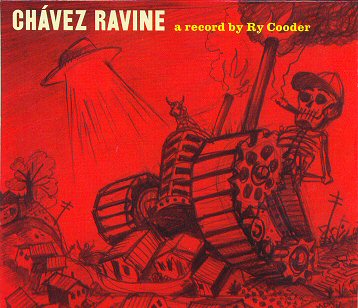
to complete and release. "Chavez Ravine- a Record
by Ry Cooder" was released in June of 2005. It
was well worth the time it took because it's a magnificent
album. Other Chicano artists were brought in to contribute
to it such as Chicano music legend Don Tosti, Little Willie
G. (formerly of Thee Midniters), Ersi Arvisu (formerly of the Sisters and
El Chicano), David Hidalgo of Los Lobos, Rudy Salas of
Tierra, and Ersi's sister, Rosella Arvisu. Other contributing
vocalists were Juliette and Carla Commagere, Bla Pahinui,
Jacob Garcia (Little Willie G's son), and of course, Ry Cooder.
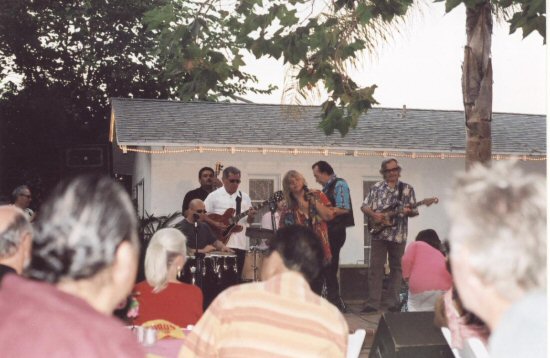
On July 17, 2005, Ry and Susan Cooder hosted a CD release
party at the home of Rosella Arvisu in Montebello, California.
It took place in her large, lush, and beautiful back yard.
Everyone involved in the project was there, musicians, engineers,
librarians, journalists, etc. It was catered with great
Mexican food and, of course, there was "live" music.
A makeshift stage was created on a patio deck. The band
was composed of Ry Cooder on guitar, his son Joachim on drums,
Mickey Lespron (formerly of El Chicano) on guitar, Rene Camacho
on bass, and a keyboardist. They backed up Little Willie
G and Ersi, Mary, and Rosella Arvisu. The music was
great and a good time was had by all. Other musicians
in attendance were Jim Keltner, Flaco Jimenez, and Rudy Salas.
I had a great time sitting at Jim Keltner's table with his
mother, wife Cynthia, and George Harrison's sister in law,
Linda Arias. They're all wonderful and down to earth people.
I understand the "Chavez Ravine" album is doing
very well in the marketplace and is receiving universal critical
acclaim. I heard it recently received three and a half
stars out of a possible four from Rolling Stone Magazine.
It was also featured on ABC's "Nightline" television
show. Ry Cooder and Little Willie G were interviewed
for the piece, which had newsworthy significance because of
the recent controversial supreme court decision regarding
eminent domain. Now the supreme court has ruled that
your house and land can be taken away, not only for freeways
and parks as in the past, but for private commercial development
that is deemed for the public good. Hopefully, this
decision will be overturned, but it's probably not likely.
The "Chavez Ravine" album will do a lot by introducing
Chicano music and artists to a wider audience and to help
the cause of Chicano music in general. The artists on
the record will also get some well- deserved attention and
recognition. The album also sheds some light on the
almost forgotten story and plight of the people of the barrio
of Chavez Ravine. Ry Cooder is a brilliant and talented
visionary who marches to his own drum. It took a person
of his genius to create a record that is both socially significant
and immensely entertaining. Some of the songs are in
English, some in Spanish, some bilingual, and others use Chicano
slang (Caló). Many styles of music are represented on
this record, yet it has a natural flow and cohesiveness.
The final recording sessions for both my dad and Don Tosti
are on this album, which serves as a monumental memorial for
both great artists. I highly recommend this record.
It'll take you to places you've never been and you'll be glad
you went.
Video and
Photo Gallery Below
Ry Cooder talks about the "Chavez Ravine" album
Ry
Cooder "Chavez Ravine" Photo Gallery
At the Recording Studio
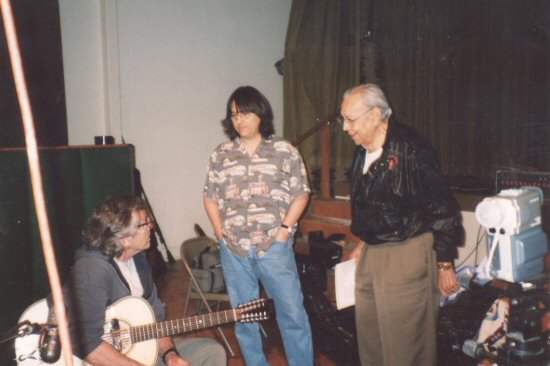
Ry Cooder, Mark Guerrero, and Lalo Guerrero
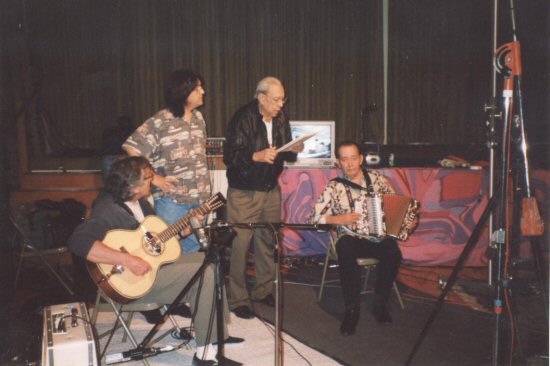
Ry Cooder, Mark, Lalo Guerrero, and Flaco
Jimenez
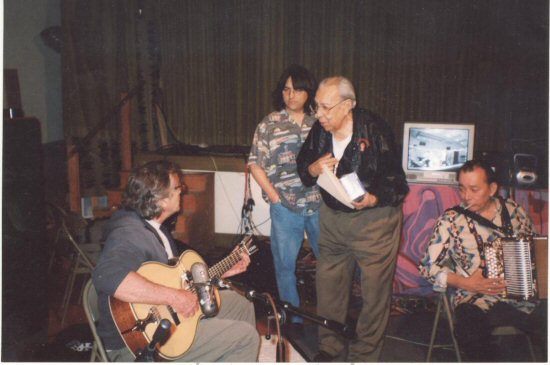
Ry Cooder, Mark, Lalo Guerrero, and Flaco
Jimenez
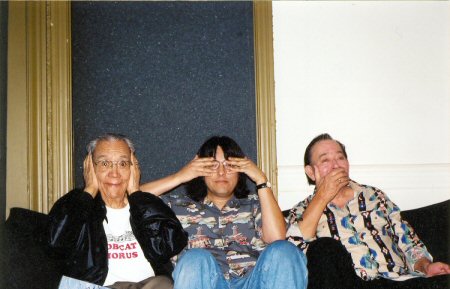
Lalo, Mark & Flaco
(hear
no evil, see no evil, speak no evil)
At
the CD Release Party
Mickey Lespron, Ersi Arvisu, Flaco Jimenez, Ry Cooder
& band
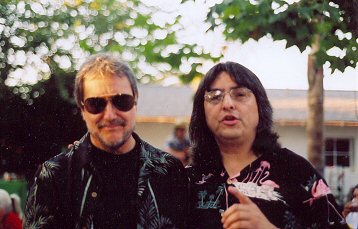
Jim Keltner & Mark Guerrero
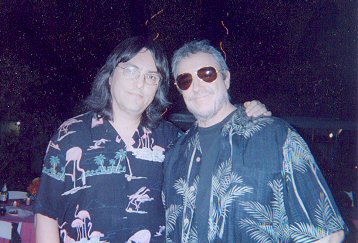
Mark Guerrero & Jim Keltner
(photo
by Cynthia Keltner)
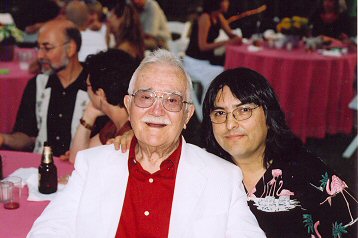
Mark & Gil Bernal
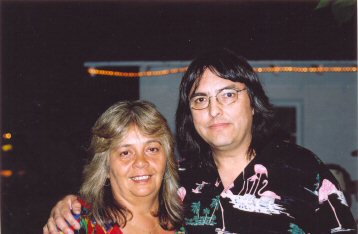
Ersi Arvisu & Mark
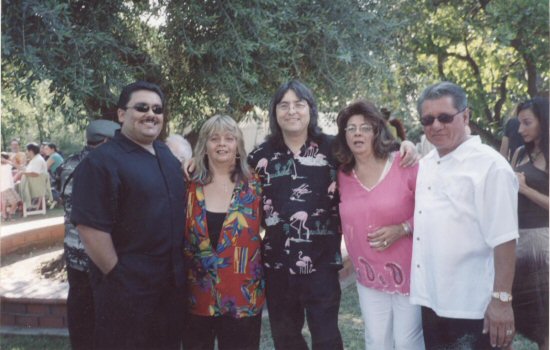
Rene Camacho, Ersi Arvisu, Mark,
Rosella Arvisu, and Mickey Lespron
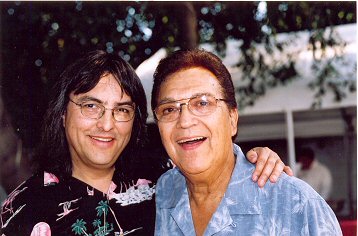
Frank Wilkinson & Mark
(Frank
Wilkinson was Director of the Housing Authority and
for the people of Chavez Ravine)
Ry Cooder Interview
on working with Lalo Guerrero on the "Chavez Ravine"
CD- From an interview with Ry Cooder by Dan Buckley for
the Tucson Citizen newspaper in 2005. Ry Cooder 2005
Interview (4 minutes 5 seconds)