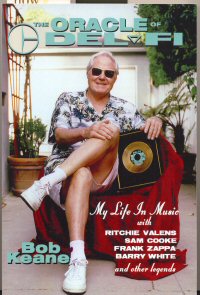
Bob Keane accomplished many great things in the music industry.
He did it all with small independent record companies such
as Keene, DelFi, Donna, Mustang, and Bronco, and managed to
get hit records with many artists. He managed to do it
because he had a great ability for recognizing talent.
Keane was the first to release records with legends Sam
Cooke, Ritchie Valens, and Frank Zappa. However, he's
been a controversial figure in regard to his reputation
among many that his business practices were less than honorable.
However, "The Oracle of DelFi" gives Bob Keane a
chance to tell his side of the story. It's an incredible
story of a man who made a fortune, lost it, and got it back
more than once. Barry White, who in the early part of
his career was an artist and A&R man for Bob Keane's Bronco
label, was quoted in his autobiography as saying that Bob
Keane had the worst karma of anyone he'd known. When
you consider that three of Keane's biggest artists died
tragically in their prime (Sam Cooke, Ritchie Valens, and
Bobby Fuller), Barry may have been right. Bob Keane
talks about all three tragedies in some detail in the book.
His life story is very interesting, on both the business
and personal sides. He went through many ups and downs
on both fronts. Since the book is also well-written,
it's hard to put down. I read it in a couple of days.
The book also gives us a glimpse into the workings of the
recording business in all its aspects; recording, distribution,
marketing, radio promotion, and touring. It also exposes
the dark underbelly of the business, i.e. the unsavory
characters and practices that abound.
Although I think it's an excellent book, I must say I was
disappointed that there was no mention of my friend, Chicano
rock pioneer Chan Romero, other than his name being listed
with Keane's roster of artists at the end of the book.
Chan, who wrote and recorded several songs for Bob Keane's
DelFi Records, had a lot of success with his song "The
Hippy Hippy Shake." Chan recorded it with Bob in
1959 and the song was subsequently performed by no less than
the Beatles. It even appeared on their "Live at
the BBC" album in 1994. "The Hippy Hippy Shake"
was also a number one hit in England for the Liverpool
band, The Swingin' Blue Jeans in 1964 and resurfaced in the late
80s by the Georgia Satellites, who recorded it for the soundtrack
of the hit movie "Cocktail." Chan had been
signed to DelFi in the wake of Ritchie Valens' death as his
heir apparent. Chan's story is far too interesting to
be omitted. Also left out of the book were East L.A.'s
60s artists the Romancers and Little Ray Jimenez, who had
some success with Bob Keane. The Romancers' "Do
the Slauson" instrumental album and Little Ray's "I
Who Have Nothing" both sold well. He merely mentions
the Sisters and Ronnie & the Pomona Casuals, also East
L.A. artists of the 60s who recorded for Keane's labels.
I and I'm sure many others would've been very interested to
have read something about all these East L.A. Chicano artists
in the book. Another important person who isn't
mentioned in the book is manager/producer Billy Cardenas,
who took most of the East L.A. artists to Bob Keane.
Billy Cardenas was my manager in the 60s and I've interviewed
him for an article on my website. I also know and have
interviewed Max Uballez of the Romancers, Ersi Arvizu of the
Sisters, Little Ray, and Ronnie of Ronnie & the Casuals, who
all have verified that Billy took them to Bob Keane.
Bob Keane does mention that he worked with a lot of Chicano
artists and prides himself on the fact that he was color blind
in his musical pursuits. It's true that he also worked
with many black artists. It must be acknowledged that
Bob Keane definitely advanced the cause of Chicanos in rock
with the success of Ritchie Valens, the aforementioned artists,
as well as the Carlos Brothers, Rene and Ray, Rosie &
Ron, and the Heartbreakers. Eddie Davis was also recording
Chicano artists at the time such as the Premiers, Cannibal
& the Headhunters, the Blendells, and many others on his
own record labels. Bob Keane and Eddie Davis were the
two main figures of the era who were recording and releasing
records by Chicano artists, some who scored hits, and should be recognized
for it.
In 1979, Bob Keane was interested in releasing one of my
recordings, "On the Boulevard." He took me to lunch
at a Japanese restaurant in Century City, California and we
discussed it. I had other parties interested in it as
well and wound up going in another direction. The song
wound up falling through the cracks and not getting released
at all at that time. Given Bob's track record and ability
to break artists, I probably made the wrong decision by not
letting him run with it. In any case, it meant
something to me that the man who "discovered" Ritchie
Valens, Bobby Fuller, Frank Zappa, and other greats thought
I had written a hit record. In any case, despite my disappointment
of what was left out of the book, I highly recommend "The
Oracle of DelFi."
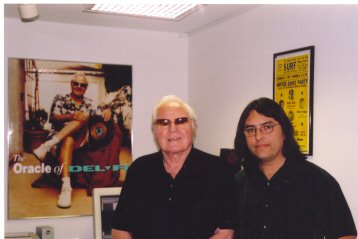
Bob Keane & Mark Guerrero (2003)
(Bob
Keane of DelFi Records produced and managed Ritchie
Valens)