"Chicano Popular Culture- Que Hable el Pueblo,"
explores Chicano popular culture in music, film, media, literature,
and art (including graffiti art). It also delves into
the fiestas and celebrations of our nations fastest growing
minority. According to the book's description on the
back cover, author Charles M. Tatum, "explains the differences
and similarities between Chicano popular culture and that
of other ethnic groups or of Anglo society and shows how Chicano
arts reflect a people's traditions and heritage."
The part of the book that directly relates to my website is
the information on Chicano music.
Tatum begins with the Spanish and Mexican music that was transplanted
to the American Southwest and follows it through to new forms
of Chicano music that are popular today. He enlightens
us on Hispanic folk music of the Southwest, describing musical
forms such as the cancion, decima, corrido, and others.
Tatum has sections on Selena, Chicano music on the West Coast
from the 60s through the 90s, Lalo Guerrero, Ritchie Valens,
Vikki Carr, Linda Ronstadt, Los Lobos, and Santana.
In another chapter he covers another subject near and dear
to me, Chicano art, particularly the muralist art movement
in East L.A. during the 60s and 70s. I knew and still
know many of the artists from that era, many of whom are still
thriving as artists. In 1981, my music was used for
a documentary which aired on PBS called "The Murals of
Aztlán." Tatum also covers the performance art
of a group called Asco (nausea), which was made up of Chicano
artists Willie Herron, Gronk, Pattsi Valdez, and writer Harry
Gamboa. Willie Herron was also founder and leader of
the 80s punk rock band, Los Illegals, who recorded an album
on A&M Records, "Internal Exile." In the chapter on Chicano cinema,
the author covers the play and movie "Zoot Suit,"
which featured my father's music (Lalo Guerrero) which
played a major part of the
artistic and commercial success of the piece.
I'm pleased and grateful when books are published on Chicano
culture, particularly the arts, because Chicano artists generally
don't get the recognition in books or the mainstream media
they so richly deserve. I'm grateful for this book
and recommend it highly. "Chicano Popular Culture"
is well researched, well-written, and full of good information.
"Chicano Popular Culture" is published by the University
of Arizona Press (2001). The book's ordering number
is ISBN 0-8165-1983-8. You can contact the publisher
at uapress.arizona.edu.
For the Record
There are some minor inaccuracies in the book that I would
like to correct for the historical record. These are
academic points that do not detract from the value of the
book. Sometimes the inaccuracies or errors result from
the original source being incorrect. However, since
this book is in fact a history book that is used in colleges
and universities, they should be addressed.
Page 32-
The book states that my dad's mother, Doña Conchita, died
when Lalo was a young man. My dad's mother, Concepción
Guerrero, passed away at the ripe old age of 86 around 1976.
Page 33-
It lists parodies written by my dad. It says that
"Tacos for Two" is a parody of "Tea for Two."
It was actually a parody of "Cocktails for Two,"
a different song entirely. It also says that "There's
No Tortillas" is a parody of "Yes, We Have No Bananas."
It's in fact a parody of "O Sole Mio," which evolved
into "It's Now or Never." On the same page,
it calls my dad's nightclub of the 60s, Lalo's Place."
It was simply called "Lalo's." This may have
come from his sources because it's mistakenly called "Lalo's
Place" in both books "Barrio Rhythms" and "Land
of a Thousand Dances." "Lalo's Place"
makes it sound like a dive, which it was not. See photo
of "Lalo's" on my website, click here.
Page 37-
It states that Romeo Prado played saxophone. He was
actually a trombonist and arranger for Thee Midniters.
Page 40-
Regarding the score for the play and movie "Zoot Suit,"
it states that much of it was composed by Lalo Guerrero and
Daniel Valdez. Not to take anything away form Daniel
Valdez, who is an excellent singer/songwriter, but all the
songs in the play "Zoot Suit" were written by my
dad, "Los Chucos Suaves," "Vamos a Bailar,"
"Marijuana Boogie," and "Chicas Patas Boogie."
However, in the case of "Chicas Pata Boogie," it
was my dad's lyric to the music of Louis Prima "Oh Babe."
When the movie came out, Daniel Valdez contributed a song
called "Handball." So it's not really fair
to say that "much of the music for the play and movie
were written by Lalo Guerrero and Daniel Valdez. On
the same page, it names the original members of Los Lobos
as Conrad Lozano, David Hidalgo, Louie Perez, and Cesar Rosas.
Conrad was not an original member. He joined a year
or two later, after having been the bassist for Tierra.

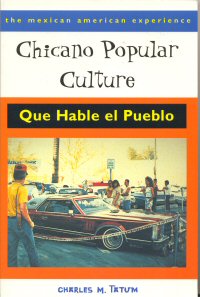 "Chicano Popular Culture- Que Hable el Pueblo,"
explores Chicano popular culture in music, film, media, literature,
and art (including graffiti art). It also delves into
the fiestas and celebrations of our nations fastest growing
minority. According to the book's description on the
back cover, author Charles M. Tatum, "explains the differences
and similarities between Chicano popular culture and that
of other ethnic groups or of Anglo society and shows how Chicano
arts reflect a people's traditions and heritage."
The part of the book that directly relates to my website is
the information on Chicano music.
"Chicano Popular Culture- Que Hable el Pueblo,"
explores Chicano popular culture in music, film, media, literature,
and art (including graffiti art). It also delves into
the fiestas and celebrations of our nations fastest growing
minority. According to the book's description on the
back cover, author Charles M. Tatum, "explains the differences
and similarities between Chicano popular culture and that
of other ethnic groups or of Anglo society and shows how Chicano
arts reflect a people's traditions and heritage."
The part of the book that directly relates to my website is
the information on Chicano music.