The Opening of the "American
Sabor" Exhibit in Seattle: October 12, 2007
by Mark Guerrero
On Friday, October 12, 2007, I flew up to Seattle, Washington
for the opening of the exhibit "American Sabor:
Latinos In U.S. Popular Music" at the Experience Music
Project Museum. I was on the advisory board for the
exhibit and a consultant for the Los Angeles section.
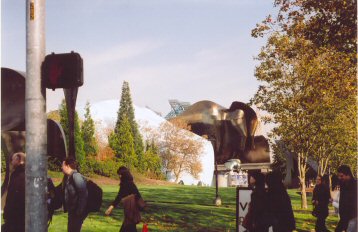
Words cannot describe the museum building, outside or inside.
It's an architectural marvel dedicated to Jimi Hendrix, who
was born in Seattle, and was designed by the famed architect,
John Gehry. The word "Experience" in Experience
Music Project comes from the name of Jimi's band, the Jimi Hendrix Experience.
I can only say that the modern, organic and wildly creative
nature of the building, particularly on the inside, gives
one the feeling that they could be having a very positive
hallucinogenic trip. That night was the V.I.P. party
and the pre-opening viewing of the exhibit. The party
was held at the museum in the "Sky Church" room,
which is huge. It has a large stage with excellent sound
and lighting systems. The term "Sky Church"
was used by Jimi Hendrix to describe a place for people to
gather together spontaneously to make music. I couldn't
possibly describe the Sky Church and do it justice, but I
came across an article written by an architectural writer
that does a pretty good job of it. This is how it's
described in the Architectural Review by Catherine Slessor:
"Clad in the stainless steel dipped in an acid bath to
generate a luscious purple iridescence, the Sky Church forms
the shimmering, voluptuous heart of the building. Red and
sky blue enameled aluminum panels, bead-blasted gold-tinted
stainless steel, and matt stainless-steel cladding are employed
on the other volumes, piling on the polychromy."
She also refers to it as "an architectural acid trip."
Getting back to my first "experience" in the Sky
Church, a great Latin band from New York called Joe Santiago
and the Salsa All Stars played while guests ate from a buffet
and enjoyed the music. Behind the band is a giant screen
(40 ft. by 70 ft, the world's largest) on which images were
projected. The images were of photos and album covers
of various artists who are in the exhibit. It was amazing
to see a photo of my dad, Lalo Guerrero, playing an acoustic
guitar in such a large scale. I also saw my own solo
album, "On the Boulevard," as well as albums by
friends of mine like the Romancers, the Premiers, and other
bands from the East L.A. music scene of the 60s.
To see these images so large while a great salsa band was
playing in such an incredible, other-worldly room and building,
was surreal, satisfying, and emotional.
That night I met the three University of Washington faculty
members, who were instrumental in spearheading the effort
to have Latino music in the U.S. be the subject of an exhibit
at the prestigious museum. They
were guest-curators Michelle Habell-Pallán, an associate professor
of women studies,
Shannon Dudley, an associate professor of ethnomusicology,
and Marisol Berríos-Miranda, who has taught ethnomusicology,
music education and Latin American studies. Michelle
is a Chicana from Los Angeles, Shannon an Anglo-American steeped
in Latino culture, and Marisol a New Yorker of Puerto Rican
descent. They worked very hard to help make the exhibit
come to fruition. Marisol was of particular value in
the New York part of the exhibit, an area where she has a
special connection and expertise, while Michelle made a special
contribution in the area of the Los Angeles punk scene of
the 80s, a scene she experienced first hand growing up in
L.A. I also
had the pleasure of meeting Jorge Santana. Coincidentally,
as I was leaving the hotel for the V.I.P. party, I ran into
Jorge in the lobby, who happened to be with a gentleman I
had met at a Cesar Chavez Foundation Dinner in Los Angeles
a few months prior. He introduced me to Jorge and we
rode in the same cab to the event. Jorge was to get
up and jam that night with the salsa band and make a good
accounting of himself. I also had the pleasure of meeting
in person for the first time, author Pablo Yglesias.
I had been talking with him on the phone and exchanging emails in regards to the "album cover wall" for the
exhibit that he was in charge of putting together. I
loaned him several album covers that he chose from my collection
for the display, including three of my dad's (Lalo Guerrero);
"Torero," "Los Exitos de Lalo Guerrero,"
and "El Celoso y La Celosa," two of mine; "Tango" and
"On the Boulevard," Tierra's first album,
"Tierra," "Eddie Cano at P.J.'s," and
an album cover and 45 record sleeve by Los Illegals, "Internal
Exile" and "El Lay." I also borrowed
an album cover of East L.A.'s Village Callers' 1968 album
"Village Callers Live" from the keyboardist of the
band, Johnny Gonzalez. It was an album cover Pablo was
looking for that I was able to find for him. Pablo Yglesias,
who's Cuban-American and a graduate of Brown University, had
compiled a book of Latino-American album covers called "Cocinando!
- Fifty Years of Latin Album Cover Art," published by
Princeton Architectural Press in 2005. I had seen it
in a local Palm Springs Latino book store and had browsed
though it about a year before our paths were to cross.
He has since graciously sent me an autographed copy of it.
Pablo also was the DJ for night, playing some great Latino
music when the band wasn't performing. Also at the event
was Ruben Molina, author of the books "The Old Barrio
Guide To Low Rider's Guide To Music- 1950 - 1975" and
"Chicano Soul." I had met and spoken with
Ruben on several occasions in L.A., but got to know him over
the two days I was in Seattle because Ruben, Pablo, and I
hung out quite a bit.
During that first night, I got my first look at the exhibit.
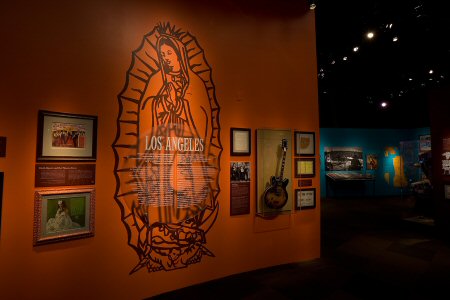
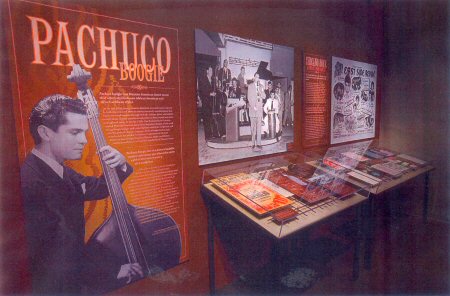
As one enters, the first part of the exhibit is the Los Angeles
section, the part for which I was a consultant. On a
wall to the left are blowups of photos of a young Don Tosti
playing the upright bass, Lalo Guerrero with his band in the
50s, and a flyer I contributed from the "West Coast Eastside
Revue" show at the Shine Auditorium in 1965. All
these images were enlarged to approximately 4 ft. by 5 ft.
It was a good feeling to see the images on such a scale.
The flyer of the show at the Shrine Auditorium had
the names and photos of singers and musicians I performed
with in the 60s and at that very event with my teenage band,
Mark & the Escorts. A glass case under the photos on the wall had artifacts such
as Chan Romero's 45 rpm record of his classic, "The Hippy
Hippy Shake," the itinerary for the Premiers first tour
(provided by manager Billy Cardenas), several of the flyers
I provided from the 60s East L.A. music scene that featured
bands such as Thee Midniters, Little Ray & the Progressions,
the Righteous Brothers, Cannibal & the Headhunters, The V.I.P.s,
the Ambertones, Mark & the Escorts, the Men From S.O.U.N.D. (my second band of the 60s), and many others.
Venues where the dances on the flyers took place include the
Big and Little Union Halls, St. Alphonsus Auditorium, The
Montebello Ballroom, East L.A. College Auditorium, and the
Shrine Auditorium. I also loaned a 1965 "Survey
of Hits" flyer from KRLA radio, which was one of the
two major rock stations in Los Angeles. Also in the
glass case were five band cards of the era I contributed,
including the original card of Los Lobos del Este de Los Angeles,
the Blendells, the Jaguars, and Mark & the Escorts.
I also loaned a business card for Faro Productions, which
was the production company of producer and record company
owner, Eddie Davis. In the middle of the Los Angeles
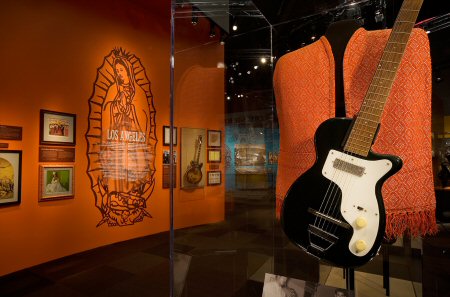
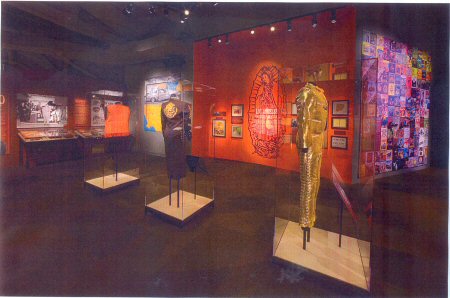
section of the exhibit are vertical glass cases. One
has a vest and guitar which belonged to the late Ritchie Valens
and another has a mariachi costume worn by Linda Ronstadt
on her "Canciones de Mi Padre" tour in the 80s.
Another wall in the L.A. section has memorabilia representing
El Chicano, Tierra, The Midniters, and others. There
is also a guitar belonging to Cesar Rosas of Los Lobos and
original manuscripts of lyrics to two Los Lobos songs, including
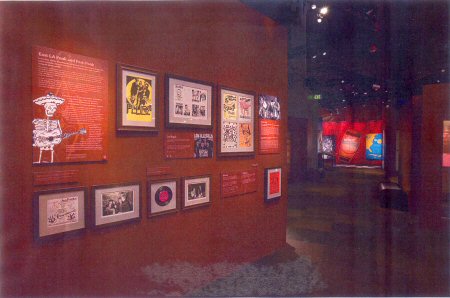
"Will the Wolf Survive." Yet another wall
in the middle of the space has posters and other artifacts
representing the L.A. punk scene of the 80s, which includes
items from Los Illegals, The Brat, and others.
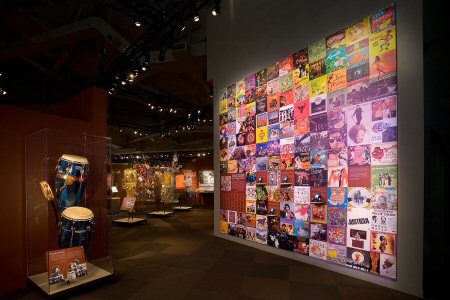
Around the first corner to the left is the album wall put
together by Pablo Yglesias. It has
album-sized scans of approximately 100 record album covers,
West Coast artists on the left and those from East Coast on
the right. The covers I provided were included on the
wall, including my "On the Boulevard" EP and "Tango"
LP, which was a rock/country rock album I made with my 70s
band, Tango on A&M Records. Attached to the wall
are small mp3 players containing a song from selected albums
that can be heard with headphones that are provided.
My albums are represented by my songs "On the Boulevard"
and "I'm Brown." There is also a kiosk where
you can push buttons and hear selected songs such as
"Angel Baby" by Rosie & the Originals, "Viva Tirado" by El Chicano, "Suavecito" by Malo,
and "El Lay" by Los Illegals. There is also
a computer screen where you can push buttons and see and hear
interviews that I conducted with artists such as Rudy &
Steve Salas of Tierra, Fred Sanchez of El Chicano, Little
Ray Jimenez, Willie Herrón of Los Illegals, the Premiers,
manager Billy Cardenas, and others. Also included is
a video clip of yours truly talking about what musically made
up the "Eastside Sound" of the 60s. I interviewed
a dozen people for the museum. The longer versions of
the interviews will be part of the museum's permanent
oral history archives. There's also a video montage
of selected bands and recordings from the mid-60s East L.A.
music scene and a screen where one can see video performances
of various artists, including one of my dad, Lalo Guerrero,
singing his classic "Cancion Mexicana" with a mariachi.
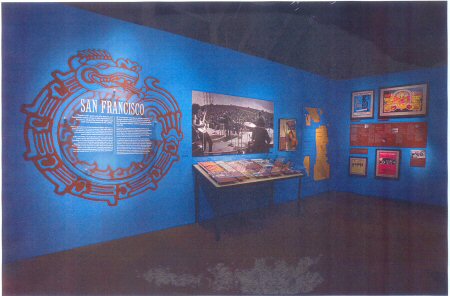
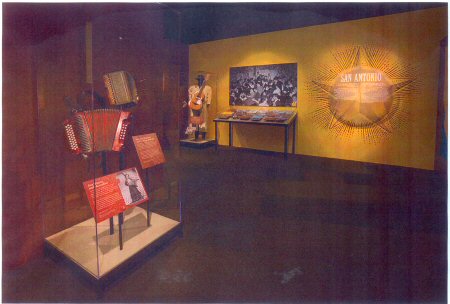
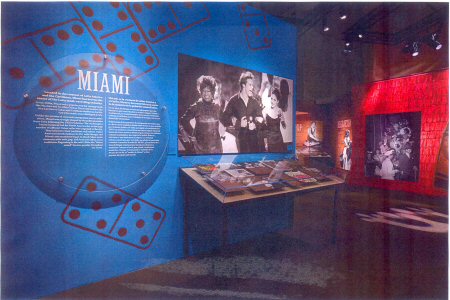
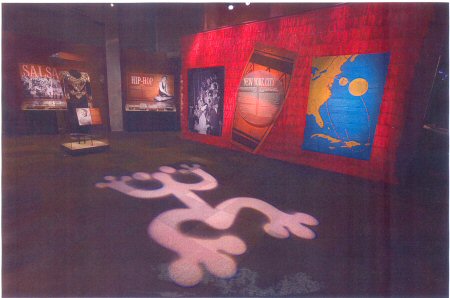
Past the Los Angeles section of the exhibit, one can see
sections on San Francisco, San Antonio, New York, and Miami.
I will not cover the details of those sections of the
exhibit because I was not involved with those parts and
don't have the same knowledge or expertise in those areas.
Suffice it to say that the other city sections of the
exhibit are equally interesting and important. I would
also hope you can experience the exhibit for yourself. It
will run through September 7, 2008 at the Experience Music
Project Museum in Seattle, after which it will travel to San
Antonio, Miami, Los Angeles, and other cities for thirteen
week runs. It's a world-class exhibit which gives great
respect and honor to Latin music in the U.S. It also
gives a well-deserved legitimacy to our music by displaying
its history in such a first-class and serious way in a major
museum.
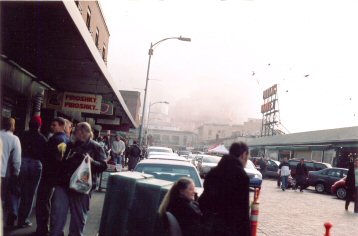
The next morning Pablo, Ruben,
and I had breakfast at the historic Pike's Place Market area
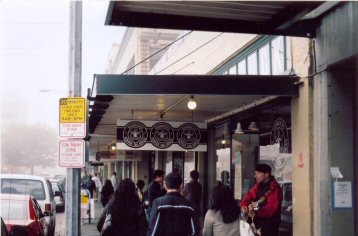
in downtown Seattle. It's the area which gave birth
to the original Starbuck's, which is still there and open
for business. We then made the long walk back to the
museum to listen to some scheduled musical performances in
the "Sky Church." Performing were a salsa
band called Tumbao and Totiyo y Amigos, a band made up of
adults fronted by a 12 or 13 year old guitarist. Most
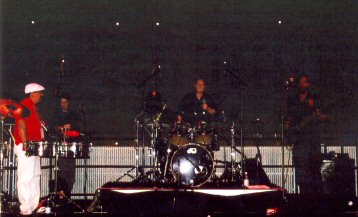
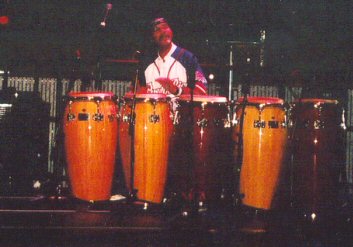
interesting was a demonstration performance by Michael Shrieve
and Michael Carabello, Santana's original drummer and conguero.
They were accompanied by bassist Alphonso Johnson, who played
on Santana's Abraxas album, and Adrian Arias, the son of Santana's
original timbalero, Chepito Areas. Michael Shrieve had
the engineer running the board play a segment of Tito Puente's
original version of "Oye Como Va" and then explained
how the Santana band adapted it to their own style.
The rhythm section then played it the way they originally
recorded it. He did the same with "Black Magic
Woman," first having the engineer play Fleetwood Mac's
original version and then playing it the way they did it with
Santana. Shrieve and Carabello played as great as ever
and Alphonso laid down the bass the way it should be done.
Adrian Arias, like his dad, is a phenomenal timbale player.
The four musicians tore it up musically and made for a very
informative and entertaining presentation.
After the
afternoon's performances, many of the musicians who had performed
that day and the previous night, as well as people involved
in putting the exhibit together, gathered for some talk and
drinks at a bar in the museum. The exhibit's curator, Jasen Emmons, was there, as well as Marisol Berrios-Miranda,
Pablo Yglesias, Ruben Molina, and many others. I had
the pleasure of meeting and complimenting Michael Shrieve
on his extraordinary playing. I had first seen him perform
with Santana in the Woodstock movie in 1970, so to see him
playing in person and better than ever thirty seven years
later was quite amazing. I also had the pleasure of
meeting and speaking with a couple of salsa singers, Joe Santiago
and Willie Torres from New York who had both sung with Tito
Puente and other top salsa bands in the 50s and 60s.
I had an extraordinary experience in Seattle, seeing the magnificent
exhibit, hearing some fantastic Latino and Latin-American
music, and meeting and hanging out with some great and talented
people. I highly recommend "American Sabor: Latinos
In U.S. Popular Music" and hope you get to experience
it at one of cities where the exhibit will be on display.
If it goes according to plan, the exhibit will be running
at various venues well into 2010.
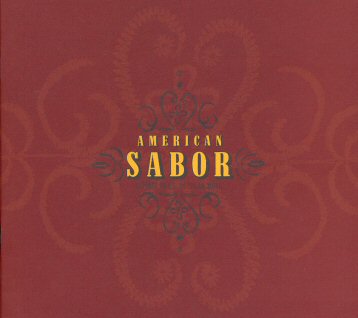
"American Sabor"
program cover
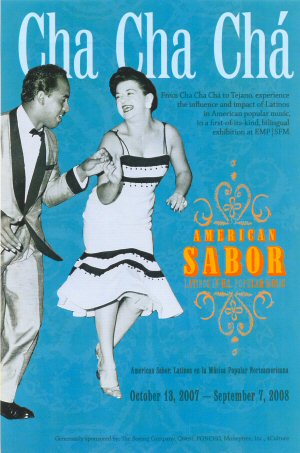
"American Sabor"
post card
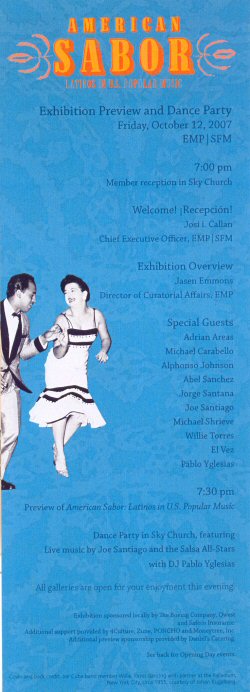
"American Sabor"
Schedule
October 12, 2007
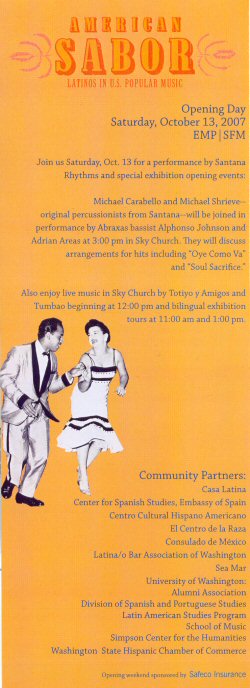
"American Sabor"
Schedule
October 13, 2007
Photo Gallery
Experience Music Project
Museum
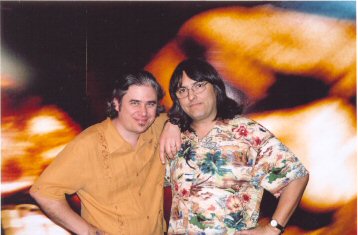
Pablo Yglesias &
Mark Guerrero
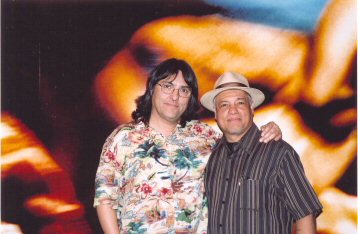
Mark Guerrero &
Ruben Molina
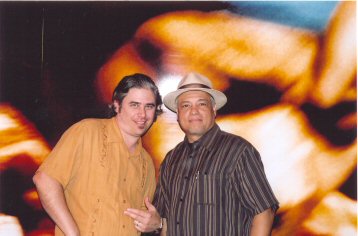
Pablo Yglesias &
Ruben Molina
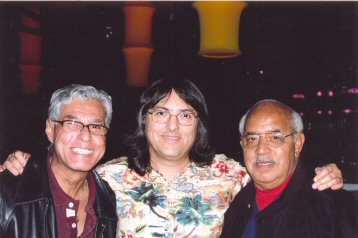
Joe Santiago, Mark
Guerrero & Willie Torres
Adrian Arias, Michael
Shrieve & Alphonso Johnson (Arias in red shirt, Shrieve on drums)
Michael Carabello
Seattle's Pike's Place
Market
Original Starbucks
in downtown Seattle
Virtual
Tour of "American Sabor" Exhibit
Below are three
photos of the exhibit provided by EMP for my website
Los Angeles wall
(on right
side of wall- Los Lobos guitar, song lyric, photo,
etc)
Ritchie Valens guitar
and vest
Album Cover Wall
(left
side west coast, right side east coast)
(Images below taken from xerox copies of photos so the quality
is not good, however they demonstrate the way the exhibit
is layed out and the first class quality of the show.)
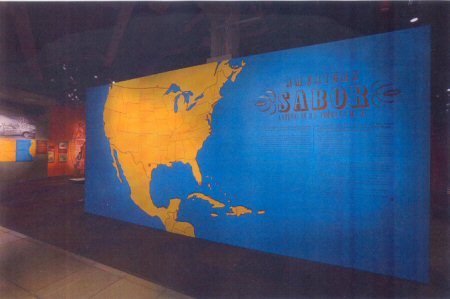
Entrance to Exhibit
Los Angeles
(large
photos on wall-
Don Tosti, Lalo Guerrero Orchestra, Eastside Revue
flyer)
Los Angeles
Los Angeles
(three
artifacts left to right-
Ritchie Valens vest and guitar, Linda Ronstadt mariachi
suit, El Vez suit)
San Francisco
San Antonio
Miami
New York
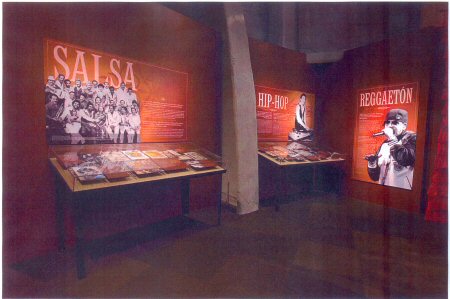
Salsa - Hip Hop - Reggaeton
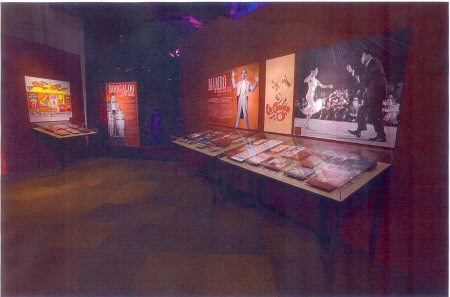
Boogaloo - Mambo
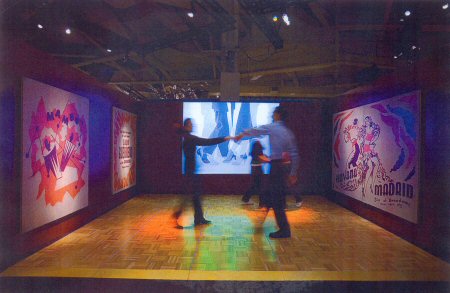
Dance Area
(back
left- Lalo Guerrero dance poster)
Exhibition
Tour Itinerary
Experience Music Project-
Seattle, Washington: October 13, 2007 - September 7,
2008
Miami Science Museum-
Miami, Florida: October 25, 2008 - May 17, 2009
Museo Alameda-
San Antonio, Texas: June 17, 2009 - September 20,
2009
Bob Bullock Texas
State History Museum- Austin, Texas: February
13, 2010 - May 16, 2010
Musical Instrument Museum- Phoenix, Arizona:
February 12, 2011 - May 15, 2011
Smithsonian Museum- Washington D.C.: July
11, 2011 - September 11, 2011