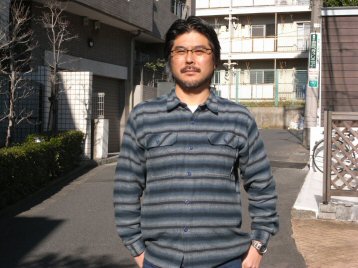
Shin Miyata, who was born and grew up in Japan, is the owner
of Barrio Gold Records/Music Camp, Inc., based in Tokyo, Japan.
He has spent a great deal of time, energy, and a lot of his
own money over the past twenty years to bring Chicano music
to Japanese audiences. Shin has reissued CDs by artists
such as Malo, Tierra, East LA Sabor Factory, Slowrider, Mezklah,
Ray Sandoval, Queztal, the Village Callers, Eastside Connection,
and various compilations. He's also released CDs by
rap artists such as Aztlán Underground, Kemo, and Aztlán Nation.
In addition, he writes articles on Chicano music and culture
for various publications in Japan, including a regular column
called "Que Pasa Aztlán" for Lowrider Japan.
Yes, you read that right, there is a Lowrider Japan and it
has around 70,000 readers. You may wonder how this all
came to be. Well, according to Shin, it all started
with him being a regular watcher and fan of the 1970s American
television show "Chips," starring Eric Estrada,
which was very popular in Japan. He liked Eric's character
of Ponch and particularly enjoyed the episodes and scenes
that depicted Chicanos and the barrios. He liked the
way they dressed, talked, and customized their cars.
He thought they were cool. This led him to movies such
as "Boulevard Nights," starring Richard Yniquez
and Danny De La Paz. When Shin graduated from high school,
he went to a Japanese University and studied Spanish.
Rather than go to Spain to practice and study the language
like most other Japanese students would normally do, Shin
took a year off from school and headed directly to East L.A.!
Orale! The year was 1984 and he was only 21 years of
age. He wound up living in the City Terrace and Boyle
Heights districts of East L.A. Through a reverend
from Japan he met at an English school in L.A., he was introduced
to the first of two Chicano families with whom he lived
during this period. Through people in these adopted
families, he was introduced to the low rider car scene, which
included cruising Whittier Boulevard listening to Chicano
music. In 1985, he attended a Cinco de Mayo concert
at Lincoln Park in East L.A., where he saw Los Lobos at a
time they were just starting to break out in a major way.
When Shin returned to Japan, he began writing articles on
Chicano music and culture. He interviewed Chicano artists
including Rudy and Steve Salas of Tierra, Poncho Sanchez,
Freddie Fender, Tejano musician Estevan Jordan, and others
for articles in various publications. Eventually Shin
got a job with a major record company, BMG Records Japan,
for whom he worked for many years. The day came however,
when Shin decided to take the leap and leave his secure job
with benefits to start his own record company. Barrio
Gold Records was born. One of the most significant contacts
for Shin in East L.A. was Hector Gonzalez of the Rampart Record
Group. Hector inherited the Rampart Records collection
of records, publishing, and archives from "Eastside Sound"
impresario of the 60s and 70s, Eddie Davis. This collection
includes recordings by legendary East L.A. groups Cannibal
& the Headhunters, the Premiers, the Blendells, El Chicano,
Little Ray Jimenez, the Village Callers, the Mixtures, Little
Willie G, the Jaguars with the Salas Brothers, and many others.
Shin has reissued various albums and compilations from this
treasure trove of seminal and historic recordings. Historic
as they are, the excitement and energy still emanate from
these recordings thirty and forty years after they were originally
recorded. In November of 2006, Shin brought Quetzal
to Japan for a promotional tour. (Quetzal is part of
a new generation of East L.A. bands who came up in the 90s.)
Shin, who's very interested in a cultural exchange between
Chicanos and the Japanese, has his own theory as to why many
Japanese youth are attracted to Chicano music and culture.
He's been quoted as saying that despite their obvious differences,
Chicanos and the Japanese share similarities. "They have
similar skin tones and are both physically small in stature.
They also share a love for music, mellow with sabor.
Japanese youth also relate to things against the mainstream,
against authority, especially because their society is so
structured and controlling. Shin has virtually
dedicated his life to Chicano music and culture. He
loves it himself and wants to share it with others in Japan.
Although there are many fans of Chicano music and culture
in Japan, at this point it's still a small niche market so
he does a lot of work for little monetary gain. Hopefully,
it will continue to grow which will be great for Chicano music
and for Shin, who deserves any rewards that come to him for
his efforts.
I first heard about Shin Miyata from Hector Gonzalez about
ten years ago in the mid-90s. I heard about him again
around 2005 from Frank Miranda, the owner of the internet
radio station from which my show "Chicano Music Chronicles"
was broadcast, crnlive.com. Both Hector and Frank had
nothing but good things to say about Shin and his efforts
to promote Chicano music in Japan. In October of 2007,
after performing with El Chicano at the Gibson Amphitheater
in Universal City, CA at the benefit for the Garfield High
School Auditorium, I was talking with Sal Rodriguez, the drummer
for War. He mentioned that I should really meet Shin
Miyata. Apparently Sal was the first Chicano music contact
with Shin. A week or so later I got an e mail from Shin
saying that he enjoyed my Chicano music website and the articles
I've written and wanted to know if there was something we
could do together to benefit Chicano music. I wrote
him back that I would be interested to talk with him about
some possibilities. We agreed to meet a couple of months
later when he would be in Southern California. Here's
the itinerary for his trip that included our meeting.
Shin flew to Mexico City for a Chicano film festival, took
a bus north to Tucson, Arizona, rented a car, and drove to
Los Angeles. Palm Springs, where I live, is on that
route 100 miles east of Los Angeles. So Shin drove directly
to my house so we could meet in person. After meeting
in person for the first time and breaking the ice so to speak,
Shin interviewed me on video for a book he's writing on Chicano
music for Japan. I, in turn, interviewed him about his
life and career for my website. He gave me two of his
recent CD releases, "Eastside Soul Classics 1963-1977"
and "Eastside Connection," which is an album recorded
by Hector Gonzalez' band of the same name in the late 70s.
The packaging for his releases are first class, with booklets
with photos and detailed information on the artists and the
songs. Shin puts tender loving care into his releases
because he cares and believes the music deserves the respect.
I gave him two of my CDs, "Tango," an album I made
with my 70s rock/country rock band of the same name, and my
solo anthology album, "On the Boulevard."
I took Shin to dinner at a unique restaurant in Palm Springs
that serves Mexican and Japanese food, a rare combination
in one restaurant. The architecture and motif of the
restaurant was Japanese because it used to be exclusively
a Japanese Restaurant. It also has a great view of the
beautiful mountain that overlooks downtown Palm Springs.
After dinner, we went to my gig downtown at Las Casuelas Terraza,
where I regularly perform in an outdoor nightclub with my
band, Hot Rox. Shin had a drink and enjoyed the music
in the beautiful setting that includes palm trees, a tropical
thatched roof bar, stage, and overhangs, lovely women, and
fresh air to breathe. I know it sounds idyllic, but
it is. After hearing a couple of sets, Shin left for
his two hour drive to Los Angeles, the final destination of
his latest trip. He figures he's made the trip
to California from Japan around fifty times to date.
I found Shin Miyata to be a very nice and personable guy who
is passionate and sincere about Chicano music and culture.
He and his story are nothing short of extraordinary.
Hopefully, our meeting is just the beginning of a mutually
beneficial relationship that will further advance the cause
of Chicano music in Japan. Shin asked me to mention
that he's interested in finding out about any Japanese-American
and Chicano interactions in East L.A., for example, Japanese-Americans
who were members of bands, car clubs, or part of the Chicano
movement. If you have any relevant information
on the subject, please e mail me at
info@markguerrero.net and I'll pass it on to Shin.
You can visit Shin Miyata's Music Camp Entertainment website
at: m-camp.net.
This article
is based on an interview by Mark Guerrero with Shin Miyata
in Palm Springs, CA on December 9, 2007.
Shin Miyata (2008)
"Our Man in Tokyo (The Ballad of Shin Miyata)"
YouTube documentary