Just as my first teenage band, Mark & the Escorts, changed
with the times becoming the Men From S.O.U.N.D. in the
mid-60s, the latter band evolved into Nineteen Eighty-Four
later in the decade. (I took the name from the title
of the classic book by George Orwell.) Of course,
there were changes in personnel with each evolution, with
the exception of the core group of Richard Rosas on bass,
Ernie Hernandez on drums, and me on guitar and vocals. Nineteen Eighty-Four, sometimes 1984, started as a four-piece band with Tony Rodas on Farfisa
organ joining the core group.
Tony was two or three years younger than the rest of us, but
was a talented and formally trained keyboard player.
Nineteen Eighty- Four was happening at the height of the psychedelic
era. Some of the popular bands at the time were Cream,
Vanilla Fudge, and Iron Butterfly. We were
playing songs by these groups, while I was starting to improve
as a songwriter. I had a couple of songs I had written
that I wanted to record so the four of us pooled some money
together to buy studio time. Since one of our favorite
bands, Buffalo Springfield, had recorded at Gold Star
Studios in Hollywood, that's the one we chose. Phil Spector and
the Beach Boys also had often used the studio
so we knew we were going to be recording on sacred ground.
Since I still have the original receipt, I
know the
bill for our four hour session was $187.43 plus $36 for the
dubs. We split the cost four ways which came to $55.86 a
piece. Since we were just
kids, ages 16 to 19, they gave us their third-string engineer,
a nice guy by the name of Pete, who also did janitorial work
at the studio from what we later heard. Nonetheless,
he did a good job and seemed to like us and the music.
On Monday, September 30, 1968, Nineteen Eighty-Four bravely
entered the hallowed halls of Gold Star Recording Studios
and recorded two of my songs, "Baba" and "Amber Waves."
In the latter song I used part of the familiar phrase from
"America the Beautiful" ("for amber waves of grain") for the
title, which in this case described a girl's amber colored
wavy hair. Generally, I pride myself on writing songs
that don't sound dated or of a particular time frame,
however, "Amber Waves" totally sounds like something written
and recorded in the psychedelic late 60s. Despite my
slight embarrassment regarding the song, particularly the
lyric, many people like it even today because it does have
the garage rock
style and sound of that era. I think it's musically
and melodically interesting, but the lyric and style of the
song are definitely at home only in that era. I played
lead guitar on my Fender Esquire through a Mosrite fuzz box,
which provided a sustain so I could play in the style
of Eric Clapton of Cream. Tony played organ much like
you might hear on an Iron Butterfly record of the era.
It was truly a psychedelic song, not only musically, but it
was about an acid trip. "Baba" was a more
commercial sounding record about the joys, effects, and benefits
of music. The track had a lot of youthful energy and
excitement. Being very well rehearsed when we entered
the studio, we walked out with a finished product on a 45
rpm acetate within the four hours we'd reserved.
Meanwhile, we were playing gigs around Los Angeles, most of
which were filled with hippies, black lights, strobe lights,
and the distinct smell of cannabis in the air. We played
one memorable gig at the Pasadena Civic Auditorium on the
bill with a pretty big recording band of the time, the Fraternity
of Man. We did another show opening for the Illinois
Speed Press, which featured guitarists Kal David and Paul
Cotton. I got to know Kal decades later in the new millennium
when we were both living and gigging in Palm Springs,
California. Paul Cotton went on to become lead guitarist
for one of my favorite bands, Poco. We did a couple
of shows on the bill with a popular local multi-racial hippie
band called Euclid Avenue Express. We also played
gigs in East Los Angeles with some of the Eastside bands who
had also evolved into the new musical era. Perhaps the
highlight of our live performances as Nineteen Eighty- Four
was a week long stint at the famous Gazzarri's on the Sunset
Strip. We shared the bill with a great band, who was
also the Gazzarri's house band, the Abstracts. The guitarist
of the Abstracts was Tony Peluso, a very talented musician.
In the 70s, he was to become the lead guitarist with the Carpenters
and for a time with Seals & Crofts. In 1981, and
again in 1982, Peluso would engineer some sessions for me
as a solo artist, backed by a band. He also produced
the '82 sessions. Tony Peluso proved to be as talented
an engineer and producer as he was a musician. A couple
of years later I worked with Tony again when I sang background
vocals and he engineered an album for a friend of mine named
Jack D'Amore, renamed Jack Street for his RCA album, produced
by the legendary Dennis Lambert of Lambert and Potter fame.
The songwriting duo of Lambert and Potter wrote many hits
in the 70s including "Ain't No Woman Like the One I've
Got" by the Four Tops, "One Tin Soldier" by
Coven, "Don't Pull Your Love" by Hamilton, Joe Frank,
and Reynolds, and many others. Lambert also produced
"Rhinestone Cowboy" by Glen Campbell and "Baby
Come Back" by Player. While working on the Jack
Street album, Dennis Lambert was interested in one of my songs
for some major artists he was going to produce, but my lawyer
blew the deal out of the water much to my disappointment.
(Jack D'Amore, aka Jack Street, and I had played together
with a great band, the Emeralds, in East L.A. in 1970.)
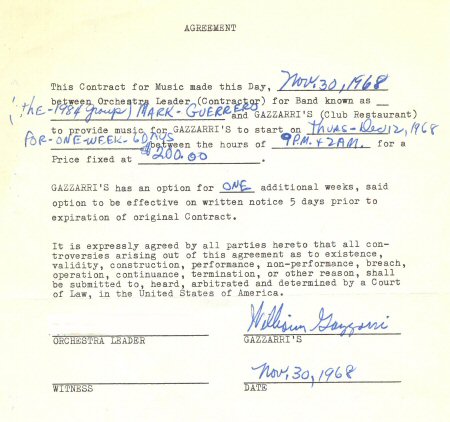
Getting back to Nineteen Eighty Four's stint at Gazzarri's
in 1968, we played six nights, alternating sets with the Abstracts,
and were paid a mere $200 for the whole week for the whole
band. We got $50 each for the week. Bands were
willing to play for such wages because of the prestige and
exposure of playing at that venue on the legendary Sunset
Strip. Nowadays, bands have to pay to play at many venues
on the strip!
The recordings Nineteen Eighty-Four had done at Gold Star
Studios led us to a recording contract with Kapp Records in
1969. Kapp was a division of MCA. (A year later
El Chicano surfaced on Kapp Records with their hit "Viva
Tirado." They went on to record six albums for
the label between 1970 and 1976.) Our road to Kapp Records
started with me pounding the pavement with our acetate in
hand. I saw an ad which led to an appointment with manager/producer
Stan Silver in Hollywood. Stan thought the recordings
were sufficiently good that he hooked us up with producer/engineer
Tommy Coe. This turned out to be very lucky for us because
Tommy took us under his wing and taught us a lot about recording.
Tommy was also a guitarist and songwriter, who had played
for some name country artists and had written a hit song called
"How the Time Flies" for Jerry Wallace. Stan
or Tommy, I'm not sure which one, decided it would be a good
idea for us to record a song by a hit songwriter. Tommy
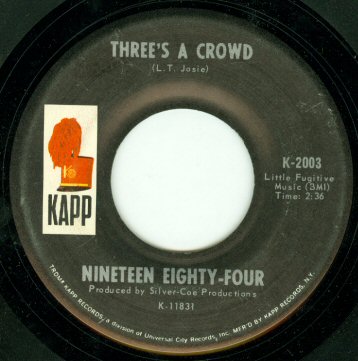
brought us a song called "Three's a Crowd" by L.T.
Josie. Josie had written "Midnight Confessions,"
which was a huge hit the year before for the Grass Roots.
"Three's a Crowd" was a good song and very commercial
like "Midnight Confessions," but I didn't want to
sing it. It wasn't really my style and I wanted to sing
my own songs so I gave it to our drummer, Ernie Hernandez,
to sing lead on it. Ernie had a very strong voice, which
stylistically suited the song very well. Maybe it was
crazy of me to not sing lead on my first record on a major
label, but that's the way it happened. It seemed like
a good idea at the time as they say. The sessions for
"Three's a Crowd" took place at American Studios
in Studio City, California, where Three Dog Night and Steppenwolf
were recording hits at the time with producer Richard Podolor.
Podolor also owned the studio. We laid down the basic
track for "Three's a Crowd" in a couple of hours.
I played a 12-string solid body Rickenbacker guitar on it.
A few days later, Tommy added a great horn section to our
track that really enhanced the record. Ernie then laid
on a strong lead vocal and Tommy did a great mix. The
recording still sounds good today. Tommy Coe used my
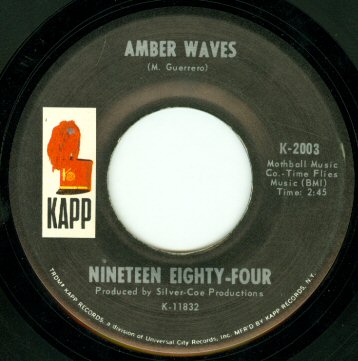
song "Amber Waves," which had already been recorded
at Gold Star, for the B side of the record, but had to edit
it down to the accepted single length of the time, under
three minutes. He had to splice out a chunk of my guitar
solo to do so.
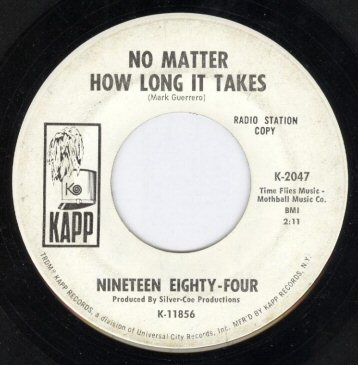
A few months later, we did a second single for Kapp, the aforementioned
"Baba" and another song I had written in the meantime,
"No Matter How Long It Takes." In this case,
we re-recorded "Baba," rather than using the one
we did at Gold Star. These sessions took place at H&
R Studios in Hollywood, owned by recording engineer Dave Hassinger,
who had recorded the Rolling Stones when he was at RCA Studios
in the mid-60s. I believe Hassinger engineered our sessions
at H&R. After laying down the basic tracks, Tommy
Coe, as he did on our first single, added a horn section to
both tracks. This second single was never released,
but I have a test pressing of it. We were very young
and didn't know exactly what happened with our Kapp Records
deal. We didn't get any promotion that I'm aware of
and didn't do any touring, or any TV or radio shows for that
matter, to promote our first single. We also didn't
have a manager, which could've helped. "Three's
a Crowd" sounds like it could have been a hit record,
but for whatever reason it didn't happen for us. At
this point, Tommy Coe and Stan Silver parted ways. Stan
Silver found success a year or two later managing the career
of his wife, country singer Donna Fargo. Donna, a very
nice lady, was a teacher at the time we were recording "Three's
a Crowd" and would sometimes be at the studio correcting
school papers in the studio office. Donna's first major
hit was "Happiest Girl In the Whole U.S.A."
She followed that success with another hit, "Funny Face,"
and went on to have a long and successful career. Tommy
Coe still liked our band, musically and as people, so he decided
to continue working with us. Tommy secured us some recording
time on speculation so we could record an album. Our
keyboard player, Tony Rodas, left the band at this time to
go to college so we decided to continue as a trio.
What was to follow was six months of recording eleven of my
songs. With Tony gone, I played various keyboard parts
on the sessions when needed, along with my guitar and lead
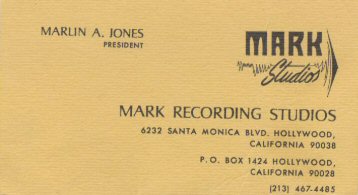
and background vocal parts. Tommy was working as an
engineer at a studio on Santa Monica Blvd. in Hollywood,
Mark Studios. (Four years later when we were recording
for A&M Records as Tango, we were to record in the same
building at that time called Clover Studios.) Tommy
had made arrangements with Mark Studios that we could record
any time the studio was not in use by paying customers.
As a result, we usually were recording from midnight to 6
or 8 a.m. During those kind of hours we could take our
time, light one up, eat, and hang out during the sessions.
We spent many hours in the studio during the six months and
had a great time. It was also like going to recording
school for free. Tommy taught us how to lock in a groove
and many other musical and technical aspects of recording.
He was like a father figure to us and we loved him.
Looking back on it, it's amazing he put so much time into
our projects with no pay. I'm forever grateful for what
Tommy Coe did for us. Another bonus for us was we got
to meet so many incredible artists who were also working at
the studio or dropping in for a visit. The list includes,
Buck Owens, Larry and Merle (the rhythm section for Loggins
& Messina), future record producers Michael Omartian and
Bill Schnee, and Hal Davis, producer of the Jackson Five.
We once saw the Jackson Five, who were kids at the time, running
around the studio.
The songs we recorded were "Lila, Love Me Tonight"
(a funky rocker), "Dare I Touch You, Marylou?" (a
song about Jamaica), "Not There At All" (an up tempo
country song), "Waiting Too Long" (a rock shuffle),
"Out In the Cold" (a slow country song with three-part harmony that we would re-record in 1972 during the Capitol
sessions), "Give Me Time" (an up tempo three part
harmony song with a country flavor), "Tugboat Tommy"
(a song for Tommy Coe, who had been a tugboat captain for
a while), "Do You Know What's Really On My Mind?"
(a Poco-style up tempo two beat country song), "Falling
Dove" (a complex ballad with a lot of harmony and some
time changes), "Little Lonely Lady" (a one
verse ditty), and "Big Brother Blues" (a reference
to the Big Brother watching over us all in George Orwell's
book). I sang lead vocals on all the tracks with the
exception of "Waiting Too Long," on which Ernie
Hernandez sang lead. When we finished the album, Tommy
went out and tried to secure us a record deal, but couldn't
make it happen. One of the problems was that as talented
a singer/songwriter and engineer/producer he was, he was not
a businessman or salesman. With the disappointment
of not getting a record deal, Nineteen Eighty-Four broke up
in 1970. Ernie and Richard continued on for a while
recording with Tommy and playing with other musicians.
I was able to get a solo record deal with legendary record
producer Lou Adler on Ode Records, Adler's record label.
The two songs I recorded for Ode were two that I had first
done with Nineteen Eighty-Four and Tommy Coe, "Lila, Love Me
Tonight" and "Dare I Touch You, Marylou?" Two years
later Richard Rosas, Ernie Hernandez, and I reunited to
record my two solo singles on Capitol Records and an album
and single in 1973 and '74 with A&M Records, under the band
name Tango. Guitarist John Valenzuela was also
on the Capitol sessions and a member of Tango. Richard
Rosas, by then known as Rick Rosas, eventually played and
recorded extensively with Joe Walsh and Neil
Young. In 1989, almost twenty years after working with
Tommy Coe and not having seen him in all those years, I found
out he was living in Florida and was no longer in the music
business. I called him and thanked him for all he did
for me and the band and he was touched and as happy to hear
from me as I was to talk with him again. I've since
lost touch with Tommy and would like to connect with him again.
During our sessions with Tommy Coe at Mark Studios, we also
recorded a single backing up my father, Lalo Guerrero.
The songs we recorded were his second version of his parody
"Pancho Claus," which this time mentioned the Beatles,
rather than Elvis, and "The Burrito," a comic rock
song in Spanish about a guy and his sweetheart sharing a burrito.
The chorus says: “I’ll bite on one end,
you’ll bite on the other, we’ll meet in the middle
and then oh brother, we’ll kiss and kiss until we smother,
and when it’s gone, we’ll order another.”
The session went so well that my dad's producer, Manuel Acuña,
hired us to play on a session with a Mexican trio called Los
Apolo, who were recording for the same label my dad was with
at the time, Cap Latino, a Latin subsidiary label of Capitol
Records. It was interesting because our electric guitar,
bass, and drums were on the same track with a Mexican acoustic
trio and it worked great. The "A" side of
the record was a rock song in Spanish called "Que Linda
Eres." It became a hit record and got a lot of
play on Spanish language radio stations. Another record
that comes to mind that we did with my dad, was his Spanish
language version of Ray Steven's comedy song, "Guitarzan."
A fun and funny part of this session was that besides his
lead vocal, my dad had to simulate a gorilla doing a vocal
bass line, Tony Rodas did the Tarzan shout, and I had to simulate
a Jane's voice with a high falsetto. During the early
parts of the song each of us had our solo part doing our character.
Near the end of the record we're all doing our parts at the
same time.
I'm writing this story of my late 60s band almost four decades
after it happened. I'm pleased that after all these
years, the Nineteen Eighty-Four recordings still sound good
to me and that we were able to make these records while still
in our late teens. It was a special time and a great
learning experience for me and the other guys in the band.
Ernie Hernandez
lead vocal on "Three's a Crowd"
Mark Guerrero lead vocal on "Amber Waves" and "No
Matter How Long It Takes"
Nineteen
Eighty Four Gallery
Nineteen Eighty Four (1969)
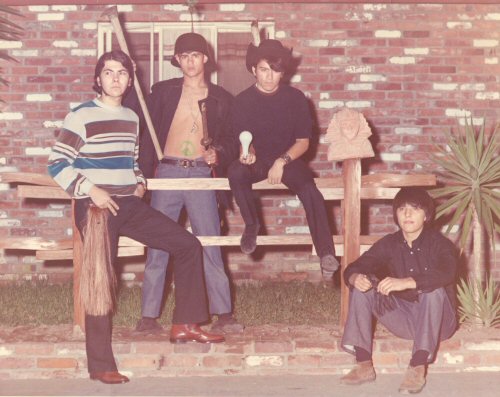
(left
to right- Rick Rosas, Tony Rodas, Ernie Hernandez,
and Mark Guerrero)
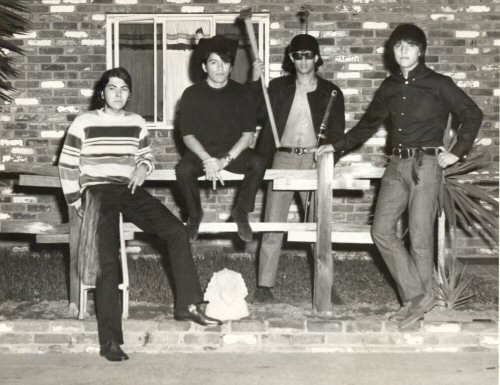
Nineteen Eighty Four (1969)
(left
to right- Rick Rosas, Tony Rodas, Ernie Hernandez,
and Mark Guerrero)
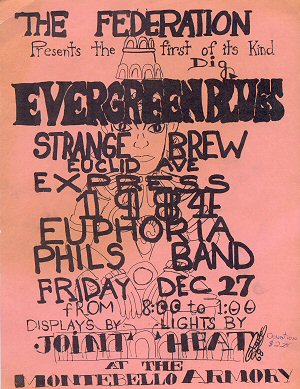
1984 at the Montebello Armory
December 27, 1968
(Euphoria's
bassist was Conrad Lozano, later to be a member of
Los Lobos and Strange Brew had Ron Reyes and Art Sanchez,
later to play with Yaqui, Cannibal & the
Headhunters, and yours truly.)
Contract
for 1984's stint at Gazzarri's
November 30, 1968
Nineteen
Eighty Four - 1969 Kapp Records A side - "Three's a Crowd" - songwriter
(L.T. Josie)
Lead vocal - Ernie Hernandez
Produced by Silver-Coe Productions
Nineteen
Eighty Four - 1969 Kapp Records
B side - "Amber Waves" - songwriter (Mark
Guerrero)
Lead Vocal - Mark Guerrero
Produced by Silver-Coe Productions
Nineteen
Eighty Four - 1969 Kapp Records
A Side - "No Matter How Long It Takes"
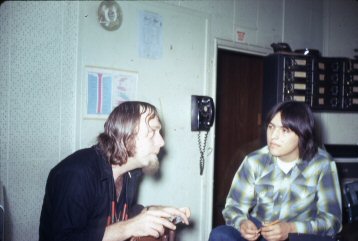
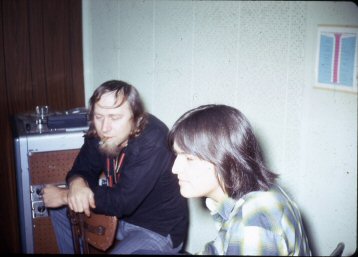
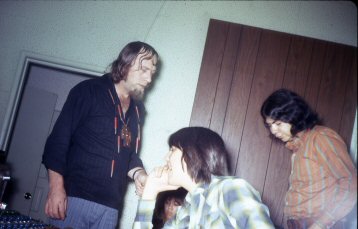
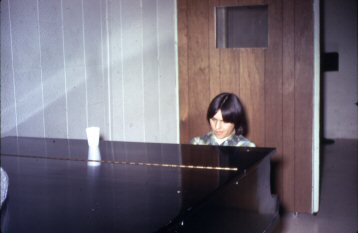
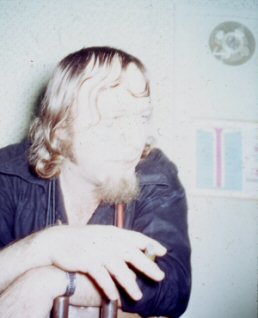
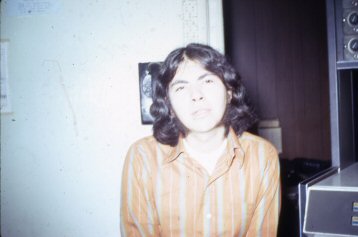
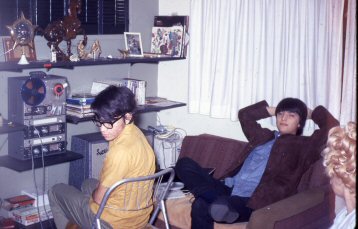
6 photos below at Mark Studios (1969)
Tommy Coe & Mark Guerrero
Tommy Coe & Mark
Guerrero
Tommy Coe, Mark Guerrero, and Rick Rosas (undentified girl in background, lower center)