Corrido Conference
Santa Barbara, California: May 8, 2008
by Mark Guerrero
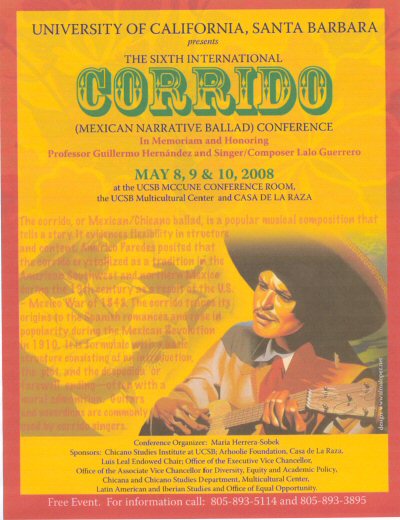
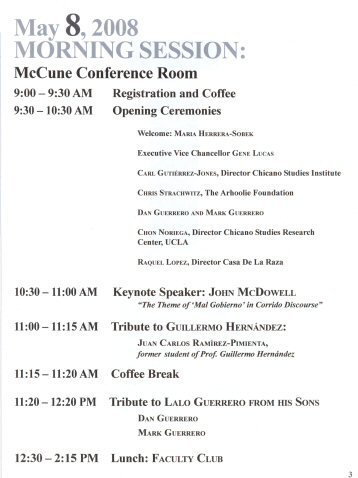
On May 8, 2008, my brother Dan and I presented a lecture/performance
at the University of California Santa Barbara in the McCune
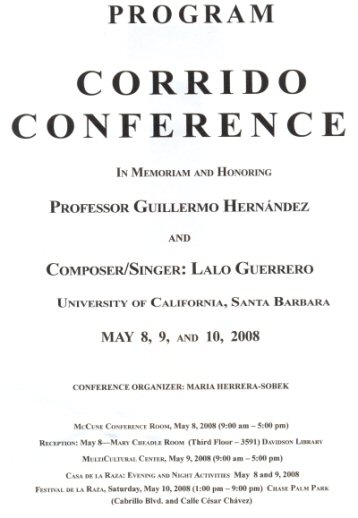
conference room. It was part of a three-day corrido
conference, which took place on May 8th, 9th, and 10th.
The event, which was organized and hosted by Maria Herrera-Sobek
and assisted by Theresa Peña, was in memoriam and honoring
our dad, Lalo Guerrero, and Professor Guillermo Hernandez.
My brother and I screened parts of my brother's documentary,
"Lalo Guerrero: The Original Chicano," spoke, took
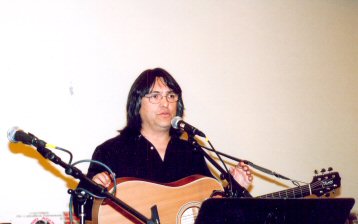
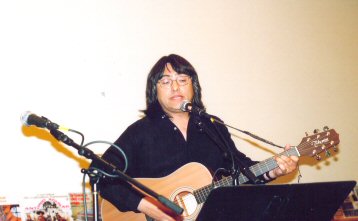
questions, and performed some corridos. I sang my dad's
"El Corrido de Delano" and my tribute song to my
dad, "The Ballad of Lalo Guerrero." I accompanied
myself on acoustic guitar on both songs. "El Corrido
de Delano" was written and recorded by my dad in the
mid 60s in support of Cesar Chavez and his farm worker's movement.
My song, "The Ballad of Lalo Guerrero," although
in English is a corrido, in this case the story of a person's
life and career. Generally speaking, a corrido is a
musical composition that tells the story of a person, place,
or event. We closed our presentation with my dad's "El
Chicano," a corrido about the joys as well as the trials
and tribulations of being a Chicano. My brother did
the vocal and I accompanied him on acoustic guitar.
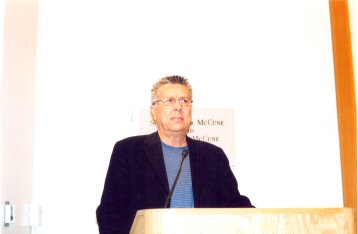
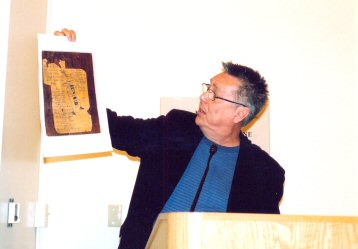
Also making presentations on our day were the following speakers,
whose names are followed by their lecture topics:
Jose Limon, "Singing it Back to the People- The Discursive
Ride of Gregorio Cortez," journalist Elijah Wald, "Vuelva
Cyberpalomita- You Tube Gives New Life to the Corrido Tradition,"
Jaime Nicolopulos, "Ignacio Parra: New Light on an Old Corrido," and Luis Leal, "Corrido de Lucio Blanco's
en su Contexto Historico." What amazed me was the
level of knowledge about corridos that these and other people
in the audience possessed. Many of them were Anglo-Americans,
who spoke Spanish fluently and could quote chapter and verse
about a certain corrido written in 1890 about a certain person
or event. They would quote lines from various verses
and translate them. Many of these people attend the
annual corrido conference every year, traveling to the host
city wherever that may be. The previous conference took
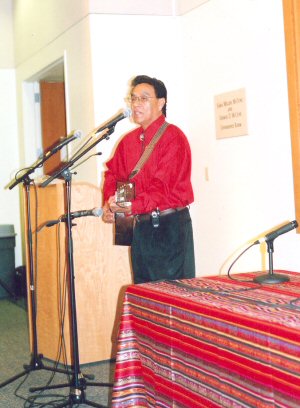
place in Monterrey, Mexico. Also making a fine musical
presentation on our day was Manuel Unzueta, who teaches at
Santa Barbara City College, He played guitar and
sang a couple of corridos. Also attending the conference
was Chris Strachwitz, owner of Arhoolie Records, who was also
a sponsor of the event. I had spoken to him on the phone
on various occasions over the years, but had never met him
in person until this day. Also in attendance was Peter
Garcia, a professor currently teaching at U.C. Santa Barbara.
I had often spoken with him on the phone regarding an
entry I wrote for the Encyclopedia of Latino Popular Culture
back in 2003. At the time he was teaching at the University
of Northern Arizona and was involved in putting the two volume
set together for Greenwood Press. This was the first
time I'd met him in person as well. I also had the pleasure
of meeting Christine Chavez, a granddaughter of Cesar Chavez,
who was also in attendance. Half way through the program,
we had an excellent buffet lunch at the faculty club, where
we were able to mingle and have some good conversation with
participants and audience members. After the day's presentations,
we all went to the Davidson Library for a reception hosted
by Sal Guereña, Director of the California Ethnic and Multicultural
Archives (CEMA), which is based there at the Davidson.
My brother Dan and I had donated my dad's archives to CEMA
several years ago and have since started our own archives at
the facility. At the reception was a great collection
of people; writers, scholars, musicians, poets, and
academics. There was another buffet, music, and some
great conversation at the reception.
In the evening most of the conference participants went to
the Casa de La Raza a few miles from the campus. There
was a band and many people getting up and singing corridos.
Earlier at the conference I had met a nice woman by the name
of Dorothy Littlejohn, who after hearing my performance of
my song, "The Ballad of Lalo Guerrero," asked me
if she could video tape me singing the song at some point
in the day. I told her I was going to the Casa de La
Raza that evening so we agreed to meet there. We found
a quiet room away from the music and revelry in the main room
that we could use for the taping. She used one camera
and somehow made the video look like a three camera shoot.
We did it in two takes. Days later she edited the tape
and put it up on you tube. After the taping my brother
and I, accompanied by Elijah Wald, went to a nice restaurant/bar
in downtown Santa Barbara and had some liquid refreshment
and some more conversation. Participating in the corrido
conference was an inspiring and fulfilling experience for
my brother and I. We worked well together and enjoyed
the whole event.
Whenever I make a trip, be it for a concert or lecture, I
try to tie in as much as I can within reason to make the most
of the journey. In this case, I had a chance to meet
with four different people who lived in the general area.
On the way up to Santa Barbara via Los Angeles, I met with
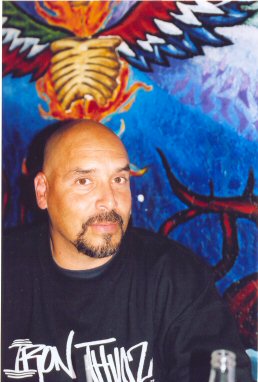
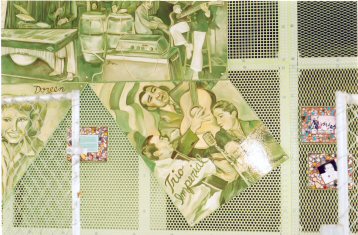
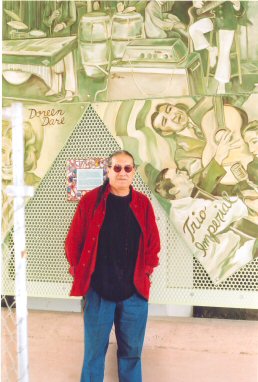
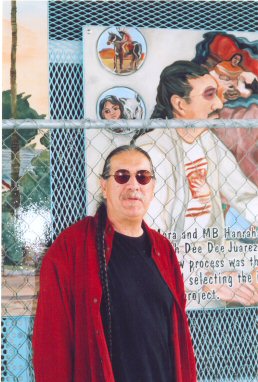
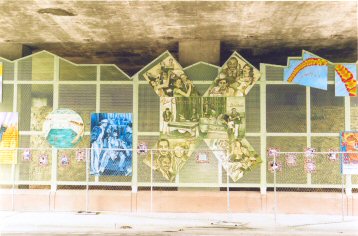
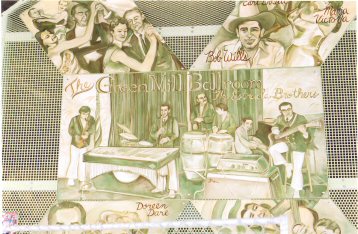
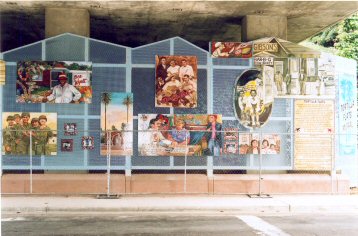
Moses Mora, one of the originators of the Tortilla Flats Mural
Project in Ventura that includes a painting of my dad with
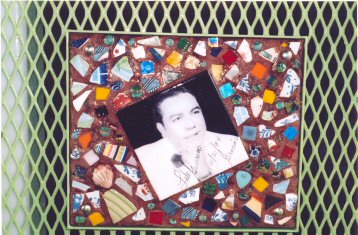
his Trio Imperial and a glossy tile with another image of
him taken from a publicity photo circa 1950. (The artist
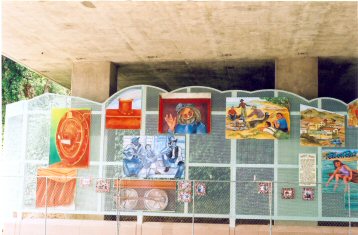
who created the mural is MB Hanrahan.) The mural, which
is made of state of the art materials, is on both sides of
a freeway underpass near Figueroa and Thompson. It also
depicts many people who were displaced from their barrio,
Tortilla Flats, for the building of a freeway system in the
late 40s and through the 50s. Their story parallels
what happened to the people displaced from Chavez Ravine to
make room for Dodger Stadium. The mural also has paintings
of other musical artists who performed at the Green Mill Ballroom
in Ventura during that time frame, artists representing a
wide range of styles such as Chuck Berry , Fats Domino, Spade
Cooley, Bob Wills & the Texas Playboys, the Lawrence Welk
Orchestra, Harry James, Luis Alcaraz, Maria Victoria, and
Lalo Guerrero. Moses showed me the mural and told me
some of the stories behind the images. We then had coffee
at a restaurant next to the mural and enjoyed some conversation
about Chicano music, Bob Dylan, rock & roll, and other
topics of mutual interest. It turns out we know some
people in common, including the recently deceased Native-American
actor/musician/activist, Floyd Red Crow Westerman.
While in Santa Barbara, I met with two local singers on the
first night. I had corresponded with them for awhile
via email and featured their CDs on my website's "What's
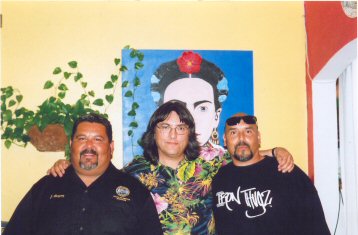
New" pages. Pepe Marquez and Anthony Prieto are
both very good singers who live in the Santa Barbara area.
We had dinner at a down home Mexican restaurant that featured
some good Mexican and Chicano artwork, including a large painting
of Frida Kahlo. The food was also excellent. We
talked about various subjects including the music scene in
Santa Barbara, which sometimes does not welcome them with
open arms. In one case they were told they wouldn't
be hired because the owners are afraid they would attract
"the element." Pepe and Anthony both also occasionally
do shows outside of the area, including in Los Angeles, where
they've been on the bill with Tierra and other top Chicano
artists. They're good guys with talent whose work I
will continue to support on my website.
On my way back
to Palm Springs, I stopped in Ventura and met with Dan Pollock
for breakfast. Dan was a guitarist for the Mixtures
in the early 60s. The Mixtures, although from the Ventura
area, are often considered part of the "Eastside Sound"
because they were managed by Eddie Davis, who also managed
and/or recorded East L.A. artists such as Cannibal & the
Headhunters, the Premiers, the Blendells, the Jaguars with
the Salas Brothers, and many more. The Mixtures are
often included in CD compilations with East L.A. groups and
their music fits right in. I had interviewed Dan for
an article I wrote on the Mixtures for my website a couple
of years before and had spoken to him on other occasions prior
to the interview. This was our first opportunity to
meet in person. Dan is a very bright man with a very
interesting personal story, which includes having played for
a time with Ike & Tina Turner. We had some great
conversation over breakfast, mostly about music. My
trip to Santa Barbara was very worthwhile and fulfilling because
in addition to the great corrido conference, I got to meet
with Moses, Pepe, Anthony, and Dan.
Santa
Barbara/Ventura Photo Gallery
Photos below at
UCSB Corrido Conference
Mark Guerrero
Dan Guerrero
Manuel Unzueta
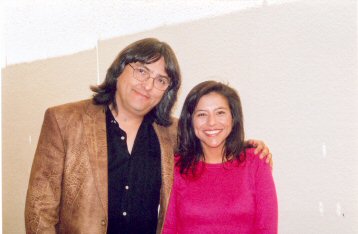
Mark Guerrero & Christine Chavez
(Christine
is a granddaughter of Cesar Chavez)
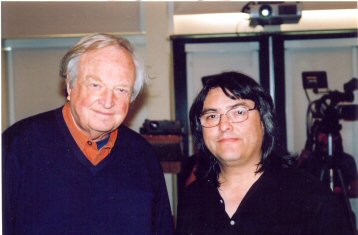
Chris Strachwitz & Mark Guerrero
(Chris
Strachwitz is the owner of Arhoolie Records)
Santa Barbara
photos below
Pepe Marquez, Mark Guerrero & Anthony Prieto
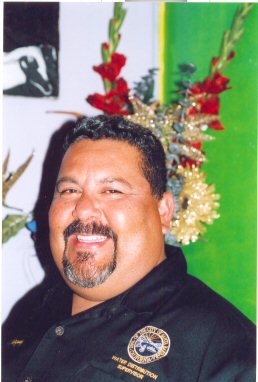
Pepe Marquez
Anthony Prieto
Ventura
photos below
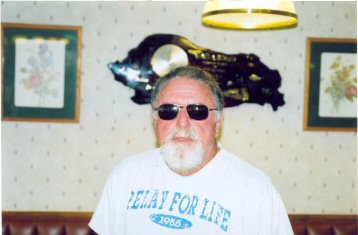
Dan Pollock
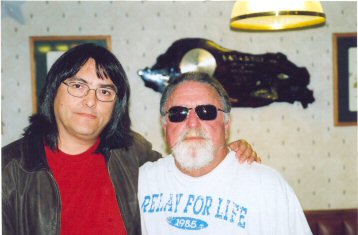
Mark Guerrero
& Dan Pollock
Sections
of the Moses Mora / MB Hanrahan Tortilla Flats mural below (Mora and Hanrahan
were project originators, Hanrahan is the artist)
Lalo Guerrero publicity photo in tile
Lalo Guerrero's Trio
Imperial
Moses Mora
Moses Mora
Musician Section
Painting of The Estrada Brothers Band
(Cougar Estrada, current drummer with Los Lobos
is the son of one of the brothers.)
Tortilla Flats section
Jerry Garcia waving top center
(Jerry Garcia & the Grateful Dead frequently
played in Ventura)
Related Links
Click
here
to see a video of the corrido conference beginning with Dan
& Mark Guerrero's presentation.