Yaqui
was a rock band of the 70s from East L.A. whose roots went
deeply back into the golden age of the East L.A. music scene
of the 60s, as did many other Eastside bands of the early
70s such as El Chicano, Tierra, Macondo, and my band of the
same era, Tango. Yaqui recorded and released a self-titled
album, "Yaqui," on Hugh Hefner's Playboy Records
in 1972 that was extremely well played, well sung, with some
very good songs. Yaqui was part of a stable of artists,
managed by Art Brambila, which also included Tierra and me, when I was a solo artist. Art secured major record
deals for all three of his artists. It was the beginning
of what we all hoped would be a Chicano Motown. For
various reasons that's not the way it worked out, but that
story is perhaps for another time and place. The members
of Yaqui were George Ochoa, lead vocals, Eddie Serrano, lead
vocals, Ronnie Reyes, lead guitar, Art Sanchez, bass, Ray
Rodriguez, drums, Larry Cronen, keyboards, and Rudy Regalado,
timbales and percussion. It's bands like Yaqui that
inspire me to work on my website. I enjoy writing about
Chicano artists who have had hits and made a name for
themselves, but I'm even more passionate writing about the
artists who were very good, or in some cases great, who slipped
through the cracks because they didn't happen to have a hit record. By writing about such artists,
I'm doing my small part to ensure they, along with their music,
will not be forgotten. Yaqui's musical style had Latin
elements, but also showed the influence of artists such as
Led Zeppelin and Crosby, Stills, & Nash. Their rock
had a hard edge, but they had excellent vocals and harmonies.
The evolution of Yaqui is indeed an interesting story.
The band evolved directly from a band called Old Tyme Religion,
which contrary to what their name might suggest, was not a
gospel group. Before I get into the story of Old Tyme
Religion, I want to give you some background information on
the individual members of Yaqui. George Ochoa, one of
the lead vocalists, with his brother John, were known as the
Slauson Brothers, who were popular in the mid-60 in East
L.A. Naming themselves after a popular dance of the
time, they were one of the artists featured on the classic
"West Coast East Side Revue, Volume 1," which had tracks by
most of the best and most popular bands of the period.
Their track was a doo wop ballad, "Rosalie."
George later became lead singer in my mid-60s band, the Men
From S.O.U.N.D., who were very active on the Eastside
circuit. In the late 60s, George Ochoa became a member
of Cannibal & the Headhunters during a period when they were
based in New York City. Eddie Serrano had been the
lead singer in a very popular Eastside band, the Enchantments.
They made several records, "I'm In Love with Your Daughter"
perhaps being the best known, was also featured on the "West
Coast East Side Revue" album. Eddie also became
a member of Cannibal & the Headhunters with George, later
becoming Cannibal with the original Cannibal's blessings when
Frankie Garcia decided to leave the music business.
(In 1968, when I was around 18 years of age, I visited my
brother Dan, who was living in New York City at the time.
While there, I visited Cannibal & the Headhunter's apartment,
running into Eddie Serrano on the street as I arrived.
We went upstairs and hung out with George Ochoa. Unfortunately,
Frankie "Cannibal" Garcia wasn't home. My
best memory was George and I riding the subways. I remember
thinking it was pretty cool and exciting that a couple of
teenagers from East L.A. were wandering around the Big Apple.)
Ronnie Reyes had been lead guitarist in the Impalas, who
often backed the Slauson Brothers, including on their
recording of "Rosalie." So George and Ronnie
went way back together.
Ronnie Reyes was later a member of a late 60s band, Strange
Brew, who did an album for ABC Records,
"A Very Strange Brew." Strange Brew, who were
named after a song by Cream, was first managed by none other
than George's real brother and former fellow Slauson Brother,
John Ochoa. However, when they were with ABC Records,
Strange Brew was managed by Jimmy King, who wrote the Grassroot's
hit song "Midnight Confessions" under the name L.T.
Josie. Both Strange Brew and my late-60s band called
1984, recorded an L.T. Josie song called "Three's a Crowd."
Getting back to the Yaqui members, Art Sanchez had played
bass for several East L.A. bands in the mid-60s including
the Unusuals and the Runabouts. Both bands played many
of the Eastside venues in the circuit we all played.
The Unusuals even went uptown and opened for the Yellow Pages
at Hollywood's Kaleidoscope Theater. Art later was a
member of Strange Brew with Ronnie Reyes.
(Other members of Strange Brew were keyboardist John Mckenian
and lead vocalist Tommy Lozano. Lozano also sang with
Cannibal & the Headhunters in New York with Frankie "Cannibal
Garcia, George Ochoa, and Eddie Serrano in 1967, the year
before my visit.) As you can already see, members of
Yaqui had played together in various bands throughout the
60s. Ray Rodriguez played drums in several popular Eastside
bands in the 60s, including the Royal Checkmates and the Fabulous
Sounds. Larry Cronen was the son of the owner of Cronen's
Music Store in Montebello, which was one of the music stores
on the Eastside that was frequented by East L.A.'s rock
musicians.
Rudy Regalado, Venezuelan drummer, timbalero, and percussionist
extraodinaire, had been a member of El Chicano before joining
Yaqui. Another significant figure in the Yaqui story
is Steve "Sparks" Millspaugh, who was a
roadie, road manager, and sound man for many years, eventually
becoming president of Yaqui, Inc.
Getting back to Old Tyme Religion as promised, George Ochoa,
Eddie Serrano, Ronnie Reyes, and Art Sanchez had all been
members prior to the formation of Yaqui. Other members
of Old Time Religion were singer/songwriter/keyboardist, Steve
Verdugo and three successive drummers; Andy Orozco, Leon Becken,
and Mark Mora. Old Time Religion recorded and released
two 45 rpm singles for Warner Brothers Records in 1971.
The first was "Glori, I Enjoy Being With You," written
and sung by George Ochoa, with "47 Cents," written
and sung by Steve Verdugo, on the flip side. The second
single consisted of "The Swimmer," written and sung
by Steve Verdugo, and "Itchy Feeling," written and
sung by George Ochoa, on the other side. Steve Verdugo
was and is a talented singer/songwriter, who had also
previously been a member of my mid-60s band, the Men From S.O.U.N.D. He had joined after George Ochoa had left.
Old Time Religion was a very good band, who aside from making
records, played a lot of night club gigs at the time, including
a long stint at Carolina Lanes in Inglewood, California.
It was a night club in a bowling alley. Carolina Lanes
was near L.A. International Airport and was an interesting
place. Previous to seeing Old Time Religion rock the
house there several times, I had seen Chuck Berry and the
Bobby Fuller Four of "I Fought the Law" fame perform
there at different times in the mid-60s. After the two
singles on Warner Brothers, Steve Verdugo and the other members
of Old Time Religion parted company due to creative differences.
Steve went on to record a single as a solo artist with producer
Eddie Davis on Davis' Gordo label. It was a very good
record with two Steve Verdugo originals, "Hollywood,"
and "My Lady." The latter song was later recorded
by Tierra on their second album, "Stranded."
The remaining members of Old Time Religion added Larry Cronen
on keyboards, Ray Rodriguez on drums, and Rudy Regalado on
timbales and percussion and changed their name to Yaqui.
The name Yaqui was inspired by a book by Carlos Castañeda,
"The Teachings of Don Juan- A Yaqui Way of Knowledge,"
which was very popular at the time. The book was about
the spiritual life and knowledge of the Yaqui Indians of Sonora,
Mexico, who often used peyote, mushrooms, and other substances
growing freely in nature to help them achieve enlightenment.
Yaqui's album was produced by Art Brambila and recorded at
several different studios, including Capitol Studios in Hollywood
and Ike and Tina Turner's Bolic Studios in Inglewood, California.
Remix production was done by Mario Panagua, who was a significant
figure in the Eastside Sound of the 60s and 70s. Mario
had been the leader and guitarist for the Jaguars with the
Salas Brothers in the mid-60s and lead guitarist and composer
on their classic instrumental "Where Lover's Go."
Mario also did remix production of Tierra's first album, "Tierra."
The Yaqui album consisted of songs written by members of Yaqui,
with the exception of their covers of "Brown Baby,"
which had previously been recorded by Little Willie G. on
Eddie Davis' Gordo Records and "She Caught the Katy
(And Left Me a Mule To Ride)," written by Taj Mahal and
Yank Rachel. The latter song is my favorite cut on the
album. It's a mid-tempo blues song that has some great
vocals by George Ochoa and Eddie Serrano that sounds as good
as a young Righteous Brothers on a good day. That's
not a knock on the Righteous Brothers for whom I have the
highest respect, but I think George and Eddie simply kicked
it up a notch. Sometimes Eddie got into Robert Plant
territory in terms of the intensity, high notes, and screaming
in his vocals. The band's arrangement and execution
is also flawless. "It's Time For a Change (Es Tiempo
Para un Cambio)," written and sung by George Ochoa, is
a high energy song, with La Bamba-style 1-4-5 chord changes
and lyrics which cry out for a change in the status quo.
This song re-appeared on the 1998 compilation CD "Ay Califas! Raza Rock" on Rhino Records and again in 2009
on Tierra's "On the Right Track" CD. Tierra
recorded the song for a video in support of the election of
Barak Obama. "Blue Harbor," also written and
sung by George Ochoa, is another excellent track obviously
inspired by Crosby, Stills, and Nash, who were at their peak
at the time. Keyboardist Larry Cronen wrote two fine
songs for the album, "Street Fight" and "Rich
Keep Getting Richer." "Mitote," written by
Ronnie Reyes, Eddie Serrano, and Art Sanchez, is another
high energy song that has George and Eddie testifying with
everything they've got. This song is one of several
that is sufficiently musically sophisticated to allow the
players to exhibit their prowess on their instruments.
The album's opening and closing songs are instrumentals,
"Sunrise" and "Sunset," written by Ronnie
Reyes and Art Sanchez. These tracks have a definite
Led Zeppelin influence with excellent guitar work by Ronnie.
After recording their album, Yaqui did some live gigs, most
memorably opening for Linda Ronstadt in Spokane, Washington.
They also played at the famed Whiskey a Go Go in Hollywood,
where they were complimented by Terry Kath and other members
of the already hugely successful band, Chicago. Yaqui
also played a lot at the Starwood Club, also in Hollywood,
where they held their own on the bill with such diverse artists
as Cheap Trick and George Clinton. According to Art
Sanchez, some of the executive staff at Yaqui's record label
were replaced right after their album came out and the replacements
didn't promote the record. This is a very common and
unfortunate occurrence in the business, which has happened
to many artists I've known. The new executives want
to bring in their own artists and would not want the artists
signed by the previous administration to succeed. That
would make the old staff look good. With the album not
performing as they'd hoped, Yaqui played on for a time and
then broke up. George Ochoa and Eddie Serrano went on
to play again with Cannibal & the Headhunters, as did
Ronnie Reyes in their back up band. In the early 2000s,
George played with Redbone of "Come and Get Your Love"
fame. (I played with George in Redbone for a short time
in 2004). Eddie Serrano tragically lost his life when
he was hit by a car while riding his bicycle in the late-90s.
Ronnie Reyes has also toured extensively backing up classic
rock stars such as Mickey Dolenz, Bobby Kimbal (formerly of
Toto), Mitch Ryder & the Detroit Wheels, the Coasters,
the Drifters, and many more. Ronnie also has been playing
in my current band, Mark Guerrero & Radio Aztlán since
2002. Art Sanchez went on to play with a power trio
with Ronnie Reyes called Josiah Blue for a time before joining
Madison Avenue Jones, which featured the Elijah horn section.
Art remembers playing a club called Smokey Stover's in Newport
Beach with the latter band when Buddy Miles came up and jammed
with them. Buddy had such a great time, he came back
every night for a week to jam. In the 90s, Art Sanchez
played a lot with Cannibal & the Headhunters, along with
Ronnie Reyes, where he was part of the band who backed many
other artists including Brenda Holloway, Roy Head, Al Wilson,
Pat Upton of the Spiral Staircase, Spencer Davis, and many
more. Art also has played with Little Ray Jimenez from
the 70s to the present. Ray Rodriguez has continued
to play, working for a few years with Redbone in the 90s.
Rudy Regalado has been very successful with his own Latin
band, Chevere, with whom he has toured the world. Rudy
has also shared the stage with Carlos Santana, Tito Puente,
Ruben Blades, Chick Corea, and many others. Rudy Regalado
also continues to play with El Chicano. Larry Cronen
is currently working with the reunited Evergreen Blues. who
were known as Elijah in the early 70s when they made two excellent
albums.
In April of 2005, I was talking on the phone with Art Brambila
and mentioned I had recently heard the Yaqui album and it
sure sounded good. I said it was a shame it's not available
anymore. Since Art now owns the Yaqui masters, on the
spot he decided to put it out in a limited release.
Art called Ray Rodriguez about the idea, who in turn called
the other former members of Yaqui and they decided to reunite
for the release. This turned into a CD release party
at The Hop in Puente Hills, California. The members
of Yaqui asked me to sit in with them to do some of the late
Eddie Serrano's vocals and I agreed. We then decided
to do a few of my songs as well and the rehearsals were on.
The very first rehearsal sounded really good right away so
we knew this would work out and be a lot of fun. On
Thursday, May 26, 2005, we performed at The Hop and it went
great. The band sounded excellent and we all enjoyed
ourselves. It's very gratifying to me to have had something
to do with getting these guys back together again even if
just for one night.
This article
is based on an audio taped telephone interview by Mark Guerrero
with Art Sanchez on May 4, 2005.
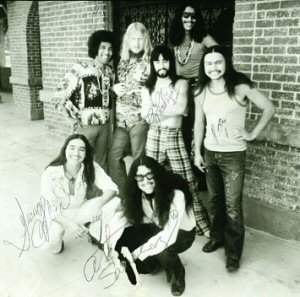
George Ochoa, Art Sanchez, Eddie Serrano, and Ray
Rodriguez
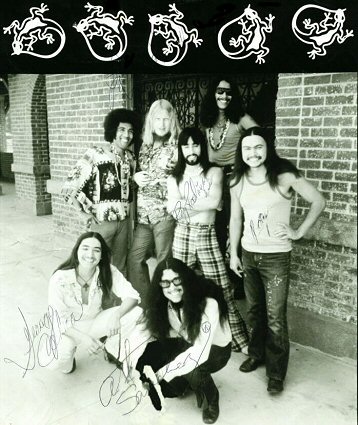
Yaqui Official publicity
photo (1973)
(standing
left to right- Rudy Regalado, Larry Cronen, Ray Rodriguez,
Eddie Serrano, and Ronnie Reyes)
(squatting left to right- George Ochoa and Art Sanchez)
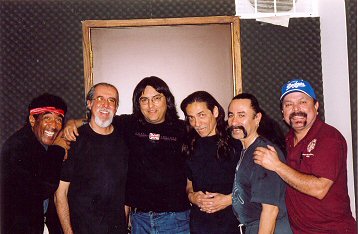
Mark Guerrero with Yaqui (2005)
(left
to right- Rudy Regalado, Art Sanchez, Mark Guerrero,
George Ochoa, Ray Rodriguez, and Ron Reyes)
Yaqui You Tube Video
Mark singing
with Yaqui at The Hop in Puente Hills, CA (2005)
"She
Caught the Katy" words and music by Taj Mahal and Yank Rachel
(Mark Guerrero on guitar and vocal)
Read about
the Yaqui reunion concert at The Hop and see two pages of
concert photos and a page of videos from the concert on my
"Miscellaneous Writings" page,article
42.
Hear
Mark's interview with George Ochoa of Yaqui
on his "Chicano Music Chronicles" podcast
by clicking the play button on the photo link below
George Ochoa and Yaqui Recordings Featured
1. It's Time For a Change (Es
Tiempo Para Un Cambio) 2. Rosalie 3. Glori, I
Enjoy Being With You 4. Itchy Feeling 5. She
Caught the Katy 6. Blue Harbor 7. I Need a Woman
8. Stop Wasting the Earth 9. Mitote 10. The
Rich Keep Getting Richer