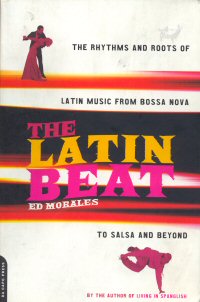
"The Latin Beat, The Rhythms and Roots of Latin Music
From Bossa Nova to Salsa and Beyond," is a brilliantly
written and well- researched history of rhythmic Latin music.
The author, Ed Morales, has written in a way that the book
can be used as an academic textbook, yet it can also be
enjoyed as a pop culture book for the layman. He writes
about the evolution of Cuban music into Salsa, the bolero,
new Latin pop, Latin jazz, the music of Brazil, music of the Carribean, the Latin influence in rock and hip hop, and the
new alternative Latin rock. The book also gives us the
history of Salsa and how the Nuyorican style emerged in New
York. "The Latin Beat" traces the roots of
the various forms of Latin music, from Africa, the Carribean,
and points beyond. Morales explains each of the Latin
music forms and informs us on their histories and countries
of origin. He also explains how the musical forms came
to the United States and influenced and altered our musical
forms by blending with American
jazz and pop artists to create new hybrids. Today one
can hear a Latin music influence in rock, rap, and popular
music in general. One can also hear the jazz, r&b,
and rock influences in Latin music. Morales helps explain
how it all came about. "The Latin Beat" has
biographical and musical histories of many legendary Latin
artists, including Tito Puente, Celia Cruz, Ruben Blades,
Eddie Palmieri, Beny More, Perez Prado, and many more.
Relating to Chicano music and my website, Morales mentions
my dad, Lalo Guerrero, and Don Tosti as pioneers in absorbing
Latin music into rock & roll in the formative days of
rock. He sites my dad's Lalo Guerrero Y Sus Cinco Lobos
and Don Tosti's Pachuco Boogie Boys as artists fusing mambo
and boogie woogie into their music in the late 40s.
The book also touches on the contributions of Chicano rockers
Ritchie Valens, Chan Romero, and Chris Montez, as well as
East L.A. groups such as Cannibal & the Headhunters and
Thee Midniters. The book touches on other mid-60s Chicano
artists such as the Champs, Question Mark & the Mysterions, and Sam
the Sham and the Pharoahs. Attention and recognition
is also given to East L.A.'s Los Lobos, who emerged in the
early 80s.
"The Latin Beat" follows the timeline to Santana
and Malo in the late 60s/early 70s, and the Latino contributors
to the punk, heavy metal, and hip hop in the U.S. The
Latin alternative music scene is surveyed with information
on Mexican bands such as Maldita Vecindad and Cafe Tacuba,
rock in Argentina, Carribean rock, rock in Spain, South American
fusion rock, and Latin Electronica. An educated guess
into the future of Latin music is also offered. Ed Morales,
who lives in Brooklyn, is the author of "Living in Spanglish:
The Search for Latino Identity in the U.S." He's
a journalist and a poet who has written for the Village Voice,
Rolling Stone, Spin, The New York Times, Miami Herald, Los
Angeles Times, and is currently the Latin music columnist
for New York Newsday. His short fiction and poetry appeared
in the collections "Iguana Dreams" and "Aloud."
Ed Morales has given us a great book, which can be utilized
as a reference book on rhythmic Latin music and it's artists.
"The Latin Beat" by Ed Morales is published by DaCapo
Press (2003)

 "The Latin Beat, The Rhythms and Roots of Latin Music
From Bossa Nova to Salsa and Beyond," is a brilliantly
written and well- researched history of rhythmic Latin music.
The author, Ed Morales, has written in a way that the book
can be used as an academic textbook, yet it can also be
enjoyed as a pop culture book for the layman. He writes
about the evolution of Cuban music into Salsa, the bolero,
new Latin pop, Latin jazz, the music of Brazil, music of the Carribean, the Latin influence in rock and hip hop, and the
new alternative Latin rock. The book also gives us the
history of Salsa and how the Nuyorican style emerged in New
York. "The Latin Beat" traces the roots of
the various forms of Latin music, from Africa, the Carribean,
and points beyond. Morales explains each of the Latin
music forms and informs us on their histories and countries
of origin. He also explains how the musical forms came
to the United States and influenced and altered our musical
forms by blending with American
jazz and pop artists to create new hybrids. Today one
can hear a Latin music influence in rock, rap, and popular
music in general. One can also hear the jazz, r&b,
and rock influences in Latin music. Morales helps explain
how it all came about. "The Latin Beat" has
biographical and musical histories of many legendary Latin
artists, including Tito Puente, Celia Cruz, Ruben Blades,
Eddie Palmieri, Beny More, Perez Prado, and many more.
"The Latin Beat, The Rhythms and Roots of Latin Music
From Bossa Nova to Salsa and Beyond," is a brilliantly
written and well- researched history of rhythmic Latin music.
The author, Ed Morales, has written in a way that the book
can be used as an academic textbook, yet it can also be
enjoyed as a pop culture book for the layman. He writes
about the evolution of Cuban music into Salsa, the bolero,
new Latin pop, Latin jazz, the music of Brazil, music of the Carribean, the Latin influence in rock and hip hop, and the
new alternative Latin rock. The book also gives us the
history of Salsa and how the Nuyorican style emerged in New
York. "The Latin Beat" traces the roots of
the various forms of Latin music, from Africa, the Carribean,
and points beyond. Morales explains each of the Latin
music forms and informs us on their histories and countries
of origin. He also explains how the musical forms came
to the United States and influenced and altered our musical
forms by blending with American
jazz and pop artists to create new hybrids. Today one
can hear a Latin music influence in rock, rap, and popular
music in general. One can also hear the jazz, r&b,
and rock influences in Latin music. Morales helps explain
how it all came about. "The Latin Beat" has
biographical and musical histories of many legendary Latin
artists, including Tito Puente, Celia Cruz, Ruben Blades,
Eddie Palmieri, Beny More, Perez Prado, and many more.