In April of 2007, I was pleased and honored to be asked to
be a consultant and be on the advisory board for a museum
exhibit called "American Sabor: Latinos in U.S. Popular
Music." The exhibit will run from
October 13, 2007 to September 7, 2008 at the Experience Music
Project- Science Fiction Museum and Hall of Fame in Seattle,
Washington. After it's eleven month run at the museum,
the exhibit will travel to various cities around the United
States. "American Sabor" presents the music
of Latinos in an interpretive and interactive museum exhibit
that focuses on five major centers of Latino popular music
production in the post-World War II United States- New York
City, Los Angeles, Miami, San Antonio, and San Francisco,
which represent the diversity of Latino music. It will
be a 5,000 square foot exhibit. Among the exhibition's
100 artifacts will be instruments, costumes, and photographs
that document the cultural history of U.S. Latinos, as well
as records that have changed the course of U.S. music history.
There will also be hands-on music making, critical listening,
and three original films created by the EMP/University of
Washington curatorial team. These elements are designed
to deepen visitors' understanding of Latino music, rhythms,
and dance. All exhibit texts will be presented in both
English and Spanish. I was hired as a consultant for
the Los Angeles part of the exhibit. The L.A. section
will include a space devoted to my dad (Lalo Guerrero), Ritchie
Valens, Don Tosti, Los Lobos, Trini Lopez, El Chicano, Tierra,
Chan Romero, and others.
As part of the exhibit development, filmed interviews of the
artists are being conducted for use in the exhibit films and
in oral history kiosks in each city section that allows visitors
to select and hear firsthand accounts of the music scenes
in the various geographical areas. The filmed interviews
will also become a part of the museum's oral history program,
which was launched in 1993 and now includes more than 500
filmed interviews with everyone from Les Paul, Rambin' Jack
Elliot and Ahmet Ertegun to Clive Davis, Robbie Robertson
and Al Green. It was agreed that I would conduct the
interviews for the Los Angeles section. I was given
a list of people to contact to be interviewed. The initial
list included Chan Romero, Cannibal & the Headhunters,
Los Lobos, Tierra, El Chicano and Thee Midniters. I
suggested many other possible interviewees. Some
that I suggested were added to the list, others were not.
The final decisions were made by the curatorial team.
The first round of interviews took place in Palm Springs,
California, where I reside. Since the interviews were
designed to stand alone, I was not on camera nor were my questions
recorded for the interview. My questions were for the
purpose of guiding the direction of the interviews.
On May 8, 2007, I interviewed Trini Lopez, who sold millions
of records in the 1960s. The interview took place at
a local photographic studio near downtown Palm Springs.
The Director of Curatorial Affairs, Jasen Emmons, could not
get to Palm Springs that day so I was entrusted to conduct
the interview on my own. An excellent local video crew
filmed the interview, which went very well and
lasted about 45 minutes. I had interviewed Trini before
and knew what to ask him about his life and career.
I was also given some questions to ask, such as how does your
Latin heritage affect your music? Also, how did the
Chicano movement affect your music? The next day, May
9th, I conducted two interviews with the same crew at the
same location. First was the leader, bassist, and founder
of El Chicano, Fred Sanchez, the second with rock
& roll pioneer, Chan Romero.
The second round of interviews took place in the Los Angeles
area on May 29th and 30th. The first day of interviews
were conducted at Studio 2425 in Monterey Park, California.
It's the home studio of the band Tierra. The curator
did fly down from Seattle for the L.A. interviews. The
artists I interviewed that day were George Delgado and Lawrence
& John Perez of the Premiers, Steve & Rudy Salas of
Tierra, and Willie Herrón of Los Illegals.
I was interviewed by the aforementioned Director of Curatorial
Affairs, Jasen Emmons. These interviews represented
a diversity of musical styles and each had a unique and interesting
story. The second day of interviews took place in a
suite at the Garden Hilton Inn in Montebello, California.
The interviewees that day were Hirth Martinez, Little Ray
Jimenez, Ersi Arvizu, and Mickey Lespron, and legendary
"Eastside Sound" record producer Billy Cardenas. Ersi and Mickey were
members of El Chicano in the 70s. I was interviewed
once again on this day. In my interviews I talked about
the early days of the East L.A. music scene of which I was
a part. I also talked about my musical career from the
60s to the present and the lives and careers of my dad and
Don Tosti, who are to be represented in the exhibit but had
passed away. I had interviewed everyone before, with
the exception of Mickey Lespron, for my website or radio show.
This afforded me a familiarity with their stories and career
highlights and made the interviews go easily and smoothly.
For the record, the two surviving members of Cannibal &
the Headhunters, Robert "Rabbit" Jaramillo and Richard
"Scar" Lopez, were invited to be interviewed, but
did not make it. Scar could not be located and Rabbit,
who had agreed to do the interview, had a job come up he had
to do. Little Willie G. of Thee Midniters was also invited
and scheduled, but cancelled the day of the interview due
to an unforeseen personal issue. Pat Vegas of Redbone
was invited, but due to a personal issue couldn't make it
to Monterey Park for the interview that day. Chris Montez
was going to be invited, but was performing in Branson, Missouri
at the time. Lastly, Rosie Hamlin of Rosie & the
Originals was asked, but was in New Mexico and couldn't make
the trip to California due to a minor illness. Due to
their touring schedule, Los Lobos is providing their own interview
that will be included in the exhibit and oral history archive.
In addition to conducting interviews, I loaned some of my
memorabilia to the exhibit. Included were ten flyers
from the 1960s era of the East L.A. music scene, known as
the "Eastside Sound." These flyers announced dances and
shows that included bands such as Cannibal & the Headhunters,
the Premiers, Thee Midniters, the Jaguars with the Salas Brothers,
my teenage bands Mark & the Escorts and The Men From S.O.U.N.D.,
and many others. Some of the flyers had lineups featuring
Eastside bands performing alongside mainstream artists such
as the Righteous Brothers, Bobby Day, and Jackie DeShannon.
I also provided a music hit parade chart from the local Los
Angeles rock station of the 60s, KRLA. It included Cannibal
& the Headhunters, Thee Midniters, and Trini Lopez on
the charts with the likes of the Rolling Stones, The Kinks,
Sam Cooke, and The Temptations. I also loaned the museum
an album cover of the "West Coast Eastside Revue"
album which had recordings of most of the top East L.A. bands
of the era, including Cannibal & the Headhunters, the
Premiers, the Blendells, my band Mark & the Escorts, and
many more. Finally, I provided five band cards from
the era, including cards of Thee Midniters, the Blendells,
the Jaguars with the Salas Brothers, Mark & the Escorts,
and an early Los Lobos card when they were called Los Lobos
del Este de Los Angeles. This very important exhibit
will show the vast contributions Latino/Chicano artists have
made to popular music throughout the decades. A contribution
that has often gone unrecognized and uncelebrated. Let
the celebration begin! For my article on the opening
of the exhibit on October 12, 2007 with a photo gallery, click
here.
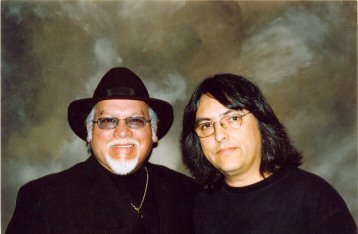
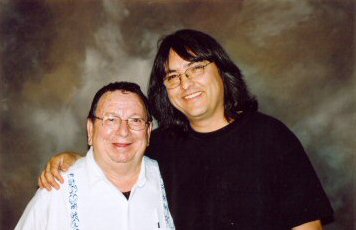
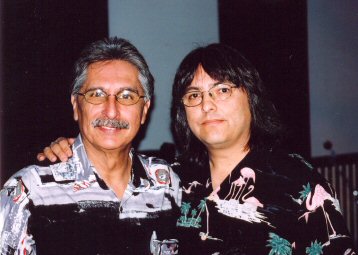
Photos with
Interviewees
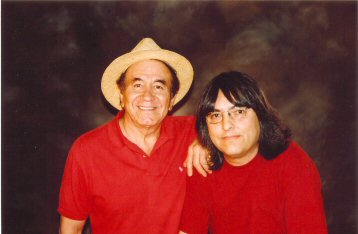
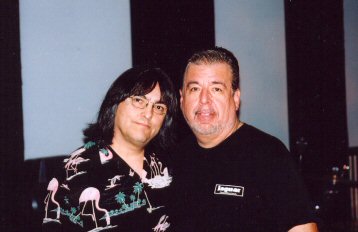
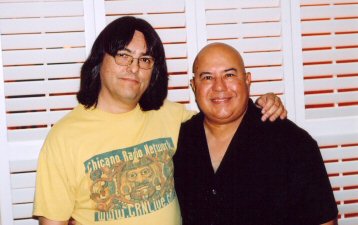
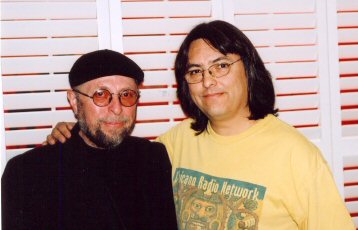
Trini Lopez & Mark Guerrero
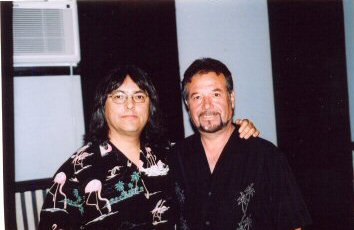
Fred Sanchez & Mark
Chan Romero & Mark
George Delgado & Mark
Mark & Rudy Salas
Mark & Steve Salas
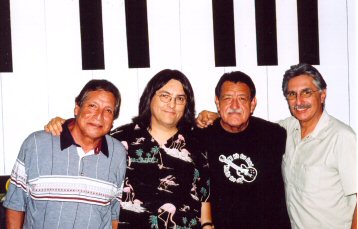
John Perez, Mark, Lawrence Perez, and George
Delgado
Billy Cardenas & Mark
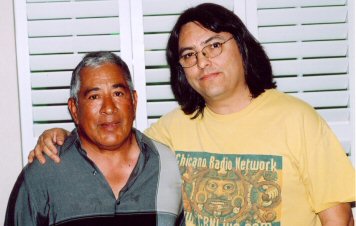
Mark & Little Ray Jimenez
Hirth Martinez & Mark
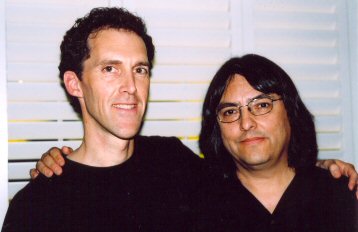
Photo with Curator
Jasen Emmons (curator) & Mark
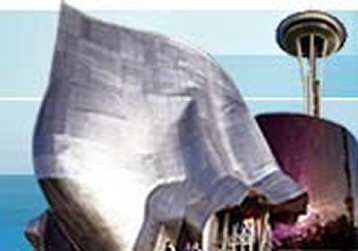
The Experience Music Project Building
Experience Music Project
Seattle, Washington
(Seattle
Space Needle in background)
Due to the number of interviews
conducted in the two days in the L.A. area, with people
coming and going on a tight schedule, we didn't get photos
of every interviewee. Interviewed but not photographed
were Willie Herrón of Los Illegals, Ersi Arvisu, and Mickey Lespron of El Chicano.
Below
are the places and dates where the exhibit has run:
Experience Music Project-
Seattle, Washington: October 13, 2007 - September 7,
2008
Miami Science Museum-
Miami, Florida: October 25, 2008 - May 17, 2009
Museo Alameda-
San Antonio, Texas: June 17, 2009 - September 20,
2009
Bob Bullock Texas
State History Museum- Austin, Texas: February
13, 2010 - May 16, 2010
Musical Instrument Museum- Phoenix, Arizona:
February 12, 2011 - May 15, 2011
Smithsonian Museum- Washington D.C.:
July 11, 2011 - September 11, 2011